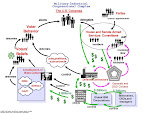
When people say, major change is possible now, here is why I believe that is true. 40 years ago entering public accounting, as an auditor, I quickly learned that the agencies and companies we audited TOTALLY understood their business, way more than we ever would. And they told us, to our faces. It hurt.
Only senior auditors in our firm, long-experienced on that particular audit, understood those clients. They did NOT need auditors and they did NOT need their owners or managers, either. Workgroups and experienced staff ran the operations.
Fast forward to the 1990s as I worked 14 years in Japan, workers and managers in Japan *totally understood* that the workers in the departments not only knew their business better than the old men, but the layers of owners, directors etc. who were nothing but a parasitic layer. So, in company after company I learned who really runs Japan and it is the workers. Nobody denies it. The owners or directors don't deny it.
Capitalism is not necessary. In fact the money system itself is not necessary, at all. Consider that *all corporations* and public sector agencies operate internally without money. You don't have to negotiate with your other departments, divisions, workgroups over prices, and there are not competing suppliers, etc. Ridiculous. No.
Read Coasian economics of the firm. Ronald Coase. Nobel laureate. This is why firms work so much better than the "private sector" competition model. Why they are eating our lunch. Because they are NOT market.
I worked 12 hours a day in the dotcom boom 2000 building P2P, person to person, transaction systems, settlement systems. We all knew it was possible We were replacing the BAMs. the Bricks and Mortar systems... before Amazon. But Wall Street de-funded the whole thing. Hard.
What is possible today is a spasm of such proportions that not only sweeps aside Capitalism (the parasitic burden of management and owners) but the use of money itself. We don't need it.
Tuesday, March 24, 2020

Saturday, February 15, 2020
Quoting https://www.nytimes.com/interactive/2020/us/politics/bernie-sanders-foreign-policy.html
Copyright New York Times.
Bernie Sanders
Senator from Vermont, 78
1. Use of Force
Presidents from both parties have taken an expansive view of their powers as commander in chief, deploying troops and ordering airstrikes without explicit congressional approval and, sometimes, without an imminent threat. The Democratic candidates frequently criticize such actions, but they have been less clear on the circumstances in which they would consider military force justifiable.
Apart from responding to an attack on the United States or a treaty ally, what are the conditions under which you would consider the use of American military force?
sanders's Answer
Bernie's first priority is to protect the American people. Military force is sometimes necessary, but always — always — as the last resort. And blustery threats of force can often signal weakness as much as strength, diminishing U.S. deterrence, credibility and security in the process.
Read full answer [sorry, the "full answer" link does not respond. --T.]
Would you consider military force for a humanitarian intervention?
sanders's Answer
Yes.
Would you consider military force to pre-empt an Iranian or North Korean nuclear or missile test?
sanders's Answer
Yes.
Would you consider military force to protect oil supplies?
sanders's Answer
No.
Is there any situation in which you could see yourself using American troops or covert action in a regime-change effort? If so, under what circumstances would you be willing to do that?
sanders's Answer
No.
Is it appropriate for the United States to provide nonmilitary support for regime-change efforts, as the Trump administration did in Venezuela?
sanders's Answer
No.
2. Iran
In 2015, the Obama administration signed a deal with Iran that lifted sanctions in exchange for significant limits on Iran’s nuclear program. Many Republicans fiercely objected to the deal, saying it was not tough enough, and in 2018, President Trump abandoned it and reinstated sanctions. But Iran kept up its end of the agreement until last month, when Mr. Trump ordered the killing of a top Iranian general, Qassim Suleimani. The killing of General Suleimani brought the United States to the brink of war with Iran, which retaliated by attacking two military bases that American forces were using in Iraq.
What would you do with the now-abandoned Iranian nuclear deal, as negotiated in 2015?
sanders's Answer
Bernie would re-enter the deal with no new preconditions, provided Iran is also meeting its commitments. He would then pursue wider talks to resolve issues of ballistic missiles, support for terrorist groups, and human rights.
Do you believe President Trump acted within his legal authority in giving the order to kill Qassim Suleimani? Was the killing justifiable? Was it wise?
sanders's Answer
No. The U.S. is not at war with Iran, and Congress has not authorized any military action against Iran. Clearly there is evidence that Suleimani was involved in acts of terror. He also supported attacks on U.S. troops in Iraq. But the right question isn't "was this a bad guy," but rather "does assassinating him make Americans safer?" The answer is clearly no.
Read full answer
Regarding possible future military action against Iran, is there any type of response that is off the table for you?
sanders's Answer
Bernie would work with our European allies to de-escalate tensions with Iran and engage in aggressive diplomacy that would safeguard the security of the U.S. and our partners while preventing a disastrous war with Iran.
What would your military strategy to deter Iran be? What would your diplomatic strategy be?
sanders's Answer
Bernie would work with our European allies to de-escalate tensions with Iran and engage in aggressive diplomacy that would safeguard the security of the U.S. and our partners while preventing a disastrous war with Iran.
3. North Korea
Dismantling North Korea’s nuclear program has long been an American priority, and President Trump has tried to do so through unusual means: direct diplomacy with the North’s leader, Kim Jong-un. It started in Singapore in 2018 but began to fall apart last February, when Mr. Trump and Mr. Kim emerged from a summit meeting in Vietnam empty-handed. In the interim, sanctions have remained, the North’s arsenal of weapons fuel and missiles has steadily expanded, and Mr. Kim recently threatened to resume missile tests.
Would you continue the personal diplomacy President Trump began with Kim Jong-un?
sanders's Answer
Yes.
Would you tighten sanctions until North Korea has given up all of its nuclear and missile programs?
sanders's Answer
No.
Would you gradually lift sanctions in return for a freeze on fissile material development, as President Clinton attempted?
sanders's Answer
Yes.
Would you insist on substantial disarmament before relieving any sanctions?
sanders's Answer
No.
Would you agree to begin withdrawing American troops from the Korean peninsula?
sanders's Answer
No, not immediately. We would work closely with our South Korean partners to move toward peace on the Korean peninsula, which is the only way we will ultimately deal with the North Korean nuclear issue.
Please describe your North Korea strategy further.
sanders's Answer
Every step we take to reduce North Korea's nuclear force, to open it up to inspections, to end the 70-year-old Korean War and to encourage peaceful relations between the Koreas and the United States increases the chances of complete denuclearization of the peninsula. Peace and nuclear disarmament must proceed in parallel, in close consultations with our South Korean ally. I will work to negotiate a step-by-step process to roll back North Korea's nuclear program, build a new peace and security regime on the peninsula, and work toward the eventual elimination of all North Korean nuclear weapons.
4. Afghanistan
The war in Afghanistan, begun after the Sept. 11 attacks, is the longest war in United States history, and documents released in December revealed that three successive presidential administrations misled the American people about the progress — or lack thereof — being made on the ground. That the United States should withdraw has become a rare point of agreement between President Trump and Democrats. But there are still significant disagreements over when, and under what conditions, that withdrawal should happen.
Would American troops be in Afghanistan at the end of your first term? If so, would you limit those troops' mission to counterterrorism and intelligence gathering?
sanders's Answer
No.
Would American presence in Afghanistan be dependent on other nations contributing troops on the ground?
sanders's Answer
No.
How long do you envision American troops being required, in any numbers, in Afghanistan?
sanders's Answer
As president, Bernie would withdraw U.S. military forces from Afghanistan as expeditiously as possible. Bernie intends to have U.S. forces out of Afghanistan by the end of his first term. Our military has now been in Afghanistan for nearly 18 years. We will soon have troops in Afghanistan who were not even born on Sept. 11, 2001. It's time to end our intervention there and bring our troops home, in a planned and coordinated way combined with a serious diplomatic and political strategy which helps deliver desperately needed humanitarian aid. Withdrawing troops does not mean withdrawing all involvement, and my administration would stay politically engaged in these countries and do whatever we can to help them develop their economy and strengthen a government that is responsible to its people.
5. Israel
In Israel, a two-state solution — long viewed as the only workable end to the Israeli-Palestinian conflict — appears more distant than ever after President Trump and Prime Minister Benjamin Netanyahu embraced a plan that appeared to tilt the outcome in Israel’s favor. Mr. Trump’s decision in 2018 to move the United States Embassy from Tel Aviv to Jerusalem was deeply polarizing. So is the B.D.S. (Boycott, Divestment and Sanctions) movement, which has grown increasingly prominent and which the House condemned in a bipartisan resolution last year.
Should the United States maintain its current level of military aid to Israel? If not, how should the level of aid change?
sanders's Answer
Yes, but that aid can be conditioned on Israel taking steps to end the occupation and move toward a peace agreement.
Bernie believes that U.S. aid should be conditioned on a range of human rights concerns. American taxpayers shouldn’t be supporting policies that undermine our values and interests, in Israel or anywhere.
Read full answer
Do you support the B.D.S. movement? If not, should the president and/or Congress act to hinder it?
sanders's Answer
No. While Bernie is not a supporter of the B.D.S. movement, he believes that Americans have a constitutional right to participate in nonviolent protest.
Should the United States Embassy in Israel be moved from Jerusalem back to Tel Aviv?
sanders's Answer
Not as a first step. But it would be on the table if Israel continues to take steps, such as settlement expansion, expulsions and home demolitions, that undermine the chances for a peace agreement.
Should all Palestinian refugees and their descendants have the right to return to Israel?
sanders's Answer
The right of refugees to return to their homes after the cessation of hostilities is an internationally recognized right, but this issue will be negotiated between Israelis and Palestinians as part of a peace agreement.
Do you support the establishment of a Palestinian state that includes West Bank land as demarcated by pre-1967 borders, except for longtime Israeli settlements?
sanders's Answer
Yes, if the settlement issue is negotiated between Israelis and Palestinians.
If you answered yes to the last question, what will you do to achieve that where past administrations have failed? If you answered no, what solution do you envision to the Israeli-Palestinian conflict?
sanders's Answer
When it comes to the Israeli-Palestinian peace process, credible United States leadership is desperately needed. Bernie is a strong supporter of the right of Israel to exist in independence, peace and security. But he also believes that the United States needs to engage in an even-handed approach toward that longstanding conflict, which results in ending the Israeli occupation and enabling the Palestinian people to have independence and self-determination in a sovereign, independent, economically viable state of their own. In his view, that end result would be in the best interests of Israel, the Palestinian people, the United States and the entire region.
Read full answer
6. Russia
Russia has been a deeply destabilizing force on the world stage for several years, including through its annexation of Crimea from Ukraine in 2014 and its meddling in the United States’ 2016 presidential election. After it annexed Crimea, it was suspended from the Group of Eight bloc of industrialized nations (now, in Russia’s absence, the Group of Seven). But President Trump has pushed to readmit Russia to the G-7 and has held several meetings with President Vladimir Putin, the contents of which have not been disclosed.
If Russia continues on its current course in Ukraine and other former Soviet states, should the United States regard it as an adversary, or even an enemy?
sanders's Answer
Yes.
Should Russia be required to return Crimea to Ukraine before it is allowed back into the G-7?
sanders's Answer
Yes.
7. China
The Chinese government has been systematically persecuting Muslim minorities: separating families, subjecting Uighurs and Kazakhs to forced labor and operating internment camps. It is also embroiled in a political crisis over Hong Kong, a special administrative region of China. At the same time, President Trump has taken a hard line on trade with China, imposing economically damaging tariffs. Last month, the United States and China signed an initial trade deal.
Should respect for Hong Kong’s political independence, under the terms of the handover agreement with Britain, be a prerequisite for normal relations and trade with China?
sanders's Answer
Yes.
Should normal relations and trade be contingent on China’s closing its internment camps for Uighurs and other Muslim minority groups?
sanders's Answer
Yes.
8. NATO
The North Atlantic Treaty Organization, a military alliance among 29 North American and European countries, has been a linchpin of the United States’ foreign policy for decades. But President Trump has often criticized the alliance, arguing that the United States gives too much and gets too little from it. During his 2016 campaign, he refused to commit to NATO’s central pledge — defending other members if they are attacked — if the members in question had not met their spending commitments, and aides say that in 2018, he repeatedly suggested withdrawing. Last year, NATO agreed to reduce the United States’ contribution and increase Germany’s.
Should NATO nations pay more for defense than their current commitment of at least 2 percent of G.D.P.?
sanders's Answer
No.
Should nations that do not fulfill their NATO funding commitment still receive an assurance of United States aid if they are attacked?
sanders's Answer
Yes.
9. Cyber Policy
Cyber weaponry has emerged as the primary way nations compete with and undercut each other in short-of-war conflict. Yet there are few international rules that govern the daily battles — or prevent escalation. As a shadow war emerges in cyberspace, President Trump has given far more powers to the United States Cyber Command and the National Security Agency.
Should a presidential order be required to launch a cyber strike against another country, just as it is required to launch a nuclear strike?
sanders's Answer
Yes.
The United States Cyber Command’s new strategy is “persistent engagement,” meaning the U.S. goes deep inside foreign computer networks to constantly engage with adversaries and dissuade strikes on the United States. Would you continue this policy?
sanders's Answer
Bernie would undertake a comprehensive review of U.S. cyber strategy and work to bring countries together around international conventions to control the use of these dangerous weapons.
If you answered yes to the last question, would you nevertheless insist that other nations pursuing “persistent engagement” could not be inside American power grids and other critical infrastructure?
sanders's Answer
Not applicable.
10. National Security Strategy
In the post-Cold War era — and especially after the Sept. 11 attacks — the focal point of American foreign policy moved to counterterrorism, the Middle East and Afghanistan. President Trump has, at least on paper, argued for shifting American foreign policy back to confront the “revisionist powers” of Russia and China.
President Trump’s national security strategy calls for shifting the focus of American foreign policy away from the Middle East and Afghanistan, and back to what it refers to as the “revisionist” superpowers, Russia and China. Do you agree? Why or why not?
sanders's Answer
Despite its stated strategy, the Trump administration has never followed a coherent national security strategy. In fact, Trump has escalated tensions in the Middle East and put us on the brink of war with Iran, refused to hold Russia accountable for its interference in our elections and human rights abuses, has done nothing to address our unfair trade agreement with China that only benefits wealthy corporations, and has ignored China's mass internment of Uighurs and its brutal repression of protesters in Hong Kong. Clearly, Trump is not a president we should be taking notes from.
Read full answer
11. Top Diplomatic Priority
The next president will be confronted with an array of foreign policy challenges, from North Korea’s nuclear program to international efforts to combat climate change. It will not be possible to address all of them at once. This makes it essential to understand not only the candidates’ policies, but also their priorities.
What would be your top priority for your secretary of state?
sanders's Answer
Bernie has long believed that the U.S. must lead the world in improving international cooperation to address shared challenges. That's why, together with his secretary of state, Bernie's administration will implement a foreign policy which focuses on democracy, human rights, environmental justice and economic fairness. Leading an international effort against the urgent threat of climate change will be a top priority.
Read full answer
How The Times Conducted This Project
In December (2019), we sent a questionnaire to the 14 Democratic presidential candidates who were then in the race. Eleven completed it, including two — Cory Booker and Marianne Williamson — who subsequently dropped out of the race.
John Delaney (who has also since dropped out) and Tulsi Gabbard did not respond, and Pete Buttigieg answered only some of the questions. The Times will update this graphic if any of them provide additional answers.
Copyright New York Times.
Bernie Sanders
Senator from Vermont, 78
1. Use of Force
Presidents from both parties have taken an expansive view of their powers as commander in chief, deploying troops and ordering airstrikes without explicit congressional approval and, sometimes, without an imminent threat. The Democratic candidates frequently criticize such actions, but they have been less clear on the circumstances in which they would consider military force justifiable.
Apart from responding to an attack on the United States or a treaty ally, what are the conditions under which you would consider the use of American military force?
sanders's Answer
Bernie's first priority is to protect the American people. Military force is sometimes necessary, but always — always — as the last resort. And blustery threats of force can often signal weakness as much as strength, diminishing U.S. deterrence, credibility and security in the process.
Read full answer [sorry, the "full answer" link does not respond. --T.]
Would you consider military force for a humanitarian intervention?
sanders's Answer
Yes.
Would you consider military force to pre-empt an Iranian or North Korean nuclear or missile test?
sanders's Answer
Yes.
Would you consider military force to protect oil supplies?
sanders's Answer
No.
Is there any situation in which you could see yourself using American troops or covert action in a regime-change effort? If so, under what circumstances would you be willing to do that?
sanders's Answer
No.
Is it appropriate for the United States to provide nonmilitary support for regime-change efforts, as the Trump administration did in Venezuela?
sanders's Answer
No.
2. Iran
In 2015, the Obama administration signed a deal with Iran that lifted sanctions in exchange for significant limits on Iran’s nuclear program. Many Republicans fiercely objected to the deal, saying it was not tough enough, and in 2018, President Trump abandoned it and reinstated sanctions. But Iran kept up its end of the agreement until last month, when Mr. Trump ordered the killing of a top Iranian general, Qassim Suleimani. The killing of General Suleimani brought the United States to the brink of war with Iran, which retaliated by attacking two military bases that American forces were using in Iraq.
What would you do with the now-abandoned Iranian nuclear deal, as negotiated in 2015?
sanders's Answer
Bernie would re-enter the deal with no new preconditions, provided Iran is also meeting its commitments. He would then pursue wider talks to resolve issues of ballistic missiles, support for terrorist groups, and human rights.
Do you believe President Trump acted within his legal authority in giving the order to kill Qassim Suleimani? Was the killing justifiable? Was it wise?
sanders's Answer
No. The U.S. is not at war with Iran, and Congress has not authorized any military action against Iran. Clearly there is evidence that Suleimani was involved in acts of terror. He also supported attacks on U.S. troops in Iraq. But the right question isn't "was this a bad guy," but rather "does assassinating him make Americans safer?" The answer is clearly no.
Read full answer
Regarding possible future military action against Iran, is there any type of response that is off the table for you?
sanders's Answer
Bernie would work with our European allies to de-escalate tensions with Iran and engage in aggressive diplomacy that would safeguard the security of the U.S. and our partners while preventing a disastrous war with Iran.
What would your military strategy to deter Iran be? What would your diplomatic strategy be?
sanders's Answer
Bernie would work with our European allies to de-escalate tensions with Iran and engage in aggressive diplomacy that would safeguard the security of the U.S. and our partners while preventing a disastrous war with Iran.
3. North Korea
Dismantling North Korea’s nuclear program has long been an American priority, and President Trump has tried to do so through unusual means: direct diplomacy with the North’s leader, Kim Jong-un. It started in Singapore in 2018 but began to fall apart last February, when Mr. Trump and Mr. Kim emerged from a summit meeting in Vietnam empty-handed. In the interim, sanctions have remained, the North’s arsenal of weapons fuel and missiles has steadily expanded, and Mr. Kim recently threatened to resume missile tests.
Would you continue the personal diplomacy President Trump began with Kim Jong-un?
sanders's Answer
Yes.
Would you tighten sanctions until North Korea has given up all of its nuclear and missile programs?
sanders's Answer
No.
Would you gradually lift sanctions in return for a freeze on fissile material development, as President Clinton attempted?
sanders's Answer
Yes.
Would you insist on substantial disarmament before relieving any sanctions?
sanders's Answer
No.
Would you agree to begin withdrawing American troops from the Korean peninsula?
sanders's Answer
No, not immediately. We would work closely with our South Korean partners to move toward peace on the Korean peninsula, which is the only way we will ultimately deal with the North Korean nuclear issue.
Please describe your North Korea strategy further.
sanders's Answer
Every step we take to reduce North Korea's nuclear force, to open it up to inspections, to end the 70-year-old Korean War and to encourage peaceful relations between the Koreas and the United States increases the chances of complete denuclearization of the peninsula. Peace and nuclear disarmament must proceed in parallel, in close consultations with our South Korean ally. I will work to negotiate a step-by-step process to roll back North Korea's nuclear program, build a new peace and security regime on the peninsula, and work toward the eventual elimination of all North Korean nuclear weapons.
4. Afghanistan
The war in Afghanistan, begun after the Sept. 11 attacks, is the longest war in United States history, and documents released in December revealed that three successive presidential administrations misled the American people about the progress — or lack thereof — being made on the ground. That the United States should withdraw has become a rare point of agreement between President Trump and Democrats. But there are still significant disagreements over when, and under what conditions, that withdrawal should happen.
Would American troops be in Afghanistan at the end of your first term? If so, would you limit those troops' mission to counterterrorism and intelligence gathering?
sanders's Answer
No.
Would American presence in Afghanistan be dependent on other nations contributing troops on the ground?
sanders's Answer
No.
How long do you envision American troops being required, in any numbers, in Afghanistan?
sanders's Answer
As president, Bernie would withdraw U.S. military forces from Afghanistan as expeditiously as possible. Bernie intends to have U.S. forces out of Afghanistan by the end of his first term. Our military has now been in Afghanistan for nearly 18 years. We will soon have troops in Afghanistan who were not even born on Sept. 11, 2001. It's time to end our intervention there and bring our troops home, in a planned and coordinated way combined with a serious diplomatic and political strategy which helps deliver desperately needed humanitarian aid. Withdrawing troops does not mean withdrawing all involvement, and my administration would stay politically engaged in these countries and do whatever we can to help them develop their economy and strengthen a government that is responsible to its people.
5. Israel
In Israel, a two-state solution — long viewed as the only workable end to the Israeli-Palestinian conflict — appears more distant than ever after President Trump and Prime Minister Benjamin Netanyahu embraced a plan that appeared to tilt the outcome in Israel’s favor. Mr. Trump’s decision in 2018 to move the United States Embassy from Tel Aviv to Jerusalem was deeply polarizing. So is the B.D.S. (Boycott, Divestment and Sanctions) movement, which has grown increasingly prominent and which the House condemned in a bipartisan resolution last year.
Should the United States maintain its current level of military aid to Israel? If not, how should the level of aid change?
sanders's Answer
Yes, but that aid can be conditioned on Israel taking steps to end the occupation and move toward a peace agreement.
Bernie believes that U.S. aid should be conditioned on a range of human rights concerns. American taxpayers shouldn’t be supporting policies that undermine our values and interests, in Israel or anywhere.
Read full answer
Do you support the B.D.S. movement? If not, should the president and/or Congress act to hinder it?
sanders's Answer
No. While Bernie is not a supporter of the B.D.S. movement, he believes that Americans have a constitutional right to participate in nonviolent protest.
Should the United States Embassy in Israel be moved from Jerusalem back to Tel Aviv?
sanders's Answer
Not as a first step. But it would be on the table if Israel continues to take steps, such as settlement expansion, expulsions and home demolitions, that undermine the chances for a peace agreement.
Should all Palestinian refugees and their descendants have the right to return to Israel?
sanders's Answer
The right of refugees to return to their homes after the cessation of hostilities is an internationally recognized right, but this issue will be negotiated between Israelis and Palestinians as part of a peace agreement.
Do you support the establishment of a Palestinian state that includes West Bank land as demarcated by pre-1967 borders, except for longtime Israeli settlements?
sanders's Answer
Yes, if the settlement issue is negotiated between Israelis and Palestinians.
If you answered yes to the last question, what will you do to achieve that where past administrations have failed? If you answered no, what solution do you envision to the Israeli-Palestinian conflict?
sanders's Answer
When it comes to the Israeli-Palestinian peace process, credible United States leadership is desperately needed. Bernie is a strong supporter of the right of Israel to exist in independence, peace and security. But he also believes that the United States needs to engage in an even-handed approach toward that longstanding conflict, which results in ending the Israeli occupation and enabling the Palestinian people to have independence and self-determination in a sovereign, independent, economically viable state of their own. In his view, that end result would be in the best interests of Israel, the Palestinian people, the United States and the entire region.
Read full answer
6. Russia
Russia has been a deeply destabilizing force on the world stage for several years, including through its annexation of Crimea from Ukraine in 2014 and its meddling in the United States’ 2016 presidential election. After it annexed Crimea, it was suspended from the Group of Eight bloc of industrialized nations (now, in Russia’s absence, the Group of Seven). But President Trump has pushed to readmit Russia to the G-7 and has held several meetings with President Vladimir Putin, the contents of which have not been disclosed.
If Russia continues on its current course in Ukraine and other former Soviet states, should the United States regard it as an adversary, or even an enemy?
sanders's Answer
Yes.
Should Russia be required to return Crimea to Ukraine before it is allowed back into the G-7?
sanders's Answer
Yes.
7. China
The Chinese government has been systematically persecuting Muslim minorities: separating families, subjecting Uighurs and Kazakhs to forced labor and operating internment camps. It is also embroiled in a political crisis over Hong Kong, a special administrative region of China. At the same time, President Trump has taken a hard line on trade with China, imposing economically damaging tariffs. Last month, the United States and China signed an initial trade deal.
Should respect for Hong Kong’s political independence, under the terms of the handover agreement with Britain, be a prerequisite for normal relations and trade with China?
sanders's Answer
Yes.
Should normal relations and trade be contingent on China’s closing its internment camps for Uighurs and other Muslim minority groups?
sanders's Answer
Yes.
8. NATO
The North Atlantic Treaty Organization, a military alliance among 29 North American and European countries, has been a linchpin of the United States’ foreign policy for decades. But President Trump has often criticized the alliance, arguing that the United States gives too much and gets too little from it. During his 2016 campaign, he refused to commit to NATO’s central pledge — defending other members if they are attacked — if the members in question had not met their spending commitments, and aides say that in 2018, he repeatedly suggested withdrawing. Last year, NATO agreed to reduce the United States’ contribution and increase Germany’s.
Should NATO nations pay more for defense than their current commitment of at least 2 percent of G.D.P.?
sanders's Answer
No.
Should nations that do not fulfill their NATO funding commitment still receive an assurance of United States aid if they are attacked?
sanders's Answer
Yes.
9. Cyber Policy
Cyber weaponry has emerged as the primary way nations compete with and undercut each other in short-of-war conflict. Yet there are few international rules that govern the daily battles — or prevent escalation. As a shadow war emerges in cyberspace, President Trump has given far more powers to the United States Cyber Command and the National Security Agency.
Should a presidential order be required to launch a cyber strike against another country, just as it is required to launch a nuclear strike?
sanders's Answer
Yes.
The United States Cyber Command’s new strategy is “persistent engagement,” meaning the U.S. goes deep inside foreign computer networks to constantly engage with adversaries and dissuade strikes on the United States. Would you continue this policy?
sanders's Answer
Bernie would undertake a comprehensive review of U.S. cyber strategy and work to bring countries together around international conventions to control the use of these dangerous weapons.
If you answered yes to the last question, would you nevertheless insist that other nations pursuing “persistent engagement” could not be inside American power grids and other critical infrastructure?
sanders's Answer
Not applicable.
10. National Security Strategy
In the post-Cold War era — and especially after the Sept. 11 attacks — the focal point of American foreign policy moved to counterterrorism, the Middle East and Afghanistan. President Trump has, at least on paper, argued for shifting American foreign policy back to confront the “revisionist powers” of Russia and China.
President Trump’s national security strategy calls for shifting the focus of American foreign policy away from the Middle East and Afghanistan, and back to what it refers to as the “revisionist” superpowers, Russia and China. Do you agree? Why or why not?
sanders's Answer
Despite its stated strategy, the Trump administration has never followed a coherent national security strategy. In fact, Trump has escalated tensions in the Middle East and put us on the brink of war with Iran, refused to hold Russia accountable for its interference in our elections and human rights abuses, has done nothing to address our unfair trade agreement with China that only benefits wealthy corporations, and has ignored China's mass internment of Uighurs and its brutal repression of protesters in Hong Kong. Clearly, Trump is not a president we should be taking notes from.
Read full answer
11. Top Diplomatic Priority
The next president will be confronted with an array of foreign policy challenges, from North Korea’s nuclear program to international efforts to combat climate change. It will not be possible to address all of them at once. This makes it essential to understand not only the candidates’ policies, but also their priorities.
What would be your top priority for your secretary of state?
sanders's Answer
Bernie has long believed that the U.S. must lead the world in improving international cooperation to address shared challenges. That's why, together with his secretary of state, Bernie's administration will implement a foreign policy which focuses on democracy, human rights, environmental justice and economic fairness. Leading an international effort against the urgent threat of climate change will be a top priority.
Read full answer
How The Times Conducted This Project
In December (2019), we sent a questionnaire to the 14 Democratic presidential candidates who were then in the race. Eleven completed it, including two — Cory Booker and Marianne Williamson — who subsequently dropped out of the race.
John Delaney (who has also since dropped out) and Tulsi Gabbard did not respond, and Pete Buttigieg answered only some of the questions. The Times will update this graphic if any of them provide additional answers.
Thursday, July 4, 2019

Sunday, November 4, 2018
Overview of proposed Cascadia Constitution
The achievement of 1787 was to design an oligarchy that has been stable for 230 years without a monarch. But it failed to protect us against oligarchy, or the present power system of NY-WashDC composted of corporations, public agencies, financial houses, military commands, etc.
We could have direct democracy (individuals vote on every significant policy decision-- at the *policy* level, the structural level. And we could, with the Internet, be enabled to change and update our votes on a continuous basis over time).
And since the world is complex, there's *no possibility* that individuals can make competent, rational choices on policies that affect them. This fact must be corrected by formal, constitutional process. For example, the federal government might be composed of 30 different agencies, similar to existing departments of transportation, environment, education, food, public health, defense, etc but many more, for example, budget, and public information. Each agency would be governed by a congressional committee which would be "tightly coupled" with its agency. All policy would be authored by the relevant agency and its governing committee.
There might not be any president at all. Who needs that guy? And there might not be any general "congress", at all, pretending to understand, know and guide everything as a whole. Which they never did, very well. Just the 30 governing committees for different aspects of the country.
Furthermore, voters would be voting on these complex and detailed operations. We would *need* the right to appoint specialists we trust-- Experts --as proxies to vote our votes on complex things like technology, medical care, pharma, finance, etc. There would be no elections for these proxies-- you could appoint anybody you like, but they might need to meet some qualifications, for the sake of everybody else in the country, not just your religious leader, your mother, etc. They could be accountable to professional licensing boards for each 30 domains, to pass tests, take continuing education, etc like other professions.
Basically I want all significant policy *choices* to be thoroughly well explained and documented in the clearest, unambiguous language. The development of this semantic framework is one of the biggest tasks. This would require some formal structure of linguists, perhaps lawyers, but deeply wise people to define the legal meaning of words, and phrases and the underlying realities of legislation. Do you understand the goals of this? It is to make voters' policy guidance exactly clear. And this would require very significant amounts of money for staff, continual investigation of agencies and definitions of the problems.
Because legislation would be exact, there would be less need for courts or high level apparatus in federal agencies to interpret or implement the law. The constitution and legislation would be properly written to anticipate problems and resolve them up front, or kicked back by the 30 agencies to their Committees' to clarify.
Basically I want to *see* the real legislation and have the right to vote on it, and expect this to happen about 100 times a year. I also want the right to delegate my vote or proxy, to experts in particular domains of expertise who I trust, for 20 or 30 categories like medical, transportation, military, foreign relations, energy, housing, toxics, climate change, etc. We MUST stop appointing one single politician for long terms of years, to decide EVERY policy that affects our lives, since they cannot possibly be expert in more than one or two of those domains.
We could have direct democracy (individuals vote on every significant policy decision-- at the *policy* level, the structural level. And we could, with the Internet, be enabled to change and update our votes on a continuous basis over time).
And since the world is complex, there's *no possibility* that individuals can make competent, rational choices on policies that affect them. This fact must be corrected by formal, constitutional process. For example, the federal government might be composed of 30 different agencies, similar to existing departments of transportation, environment, education, food, public health, defense, etc but many more, for example, budget, and public information. Each agency would be governed by a congressional committee which would be "tightly coupled" with its agency. All policy would be authored by the relevant agency and its governing committee.
There might not be any president at all. Who needs that guy? And there might not be any general "congress", at all, pretending to understand, know and guide everything as a whole. Which they never did, very well. Just the 30 governing committees for different aspects of the country.
Furthermore, voters would be voting on these complex and detailed operations. We would *need* the right to appoint specialists we trust-- Experts --as proxies to vote our votes on complex things like technology, medical care, pharma, finance, etc. There would be no elections for these proxies-- you could appoint anybody you like, but they might need to meet some qualifications, for the sake of everybody else in the country, not just your religious leader, your mother, etc. They could be accountable to professional licensing boards for each 30 domains, to pass tests, take continuing education, etc like other professions.
Basically I want all significant policy *choices* to be thoroughly well explained and documented in the clearest, unambiguous language. The development of this semantic framework is one of the biggest tasks. This would require some formal structure of linguists, perhaps lawyers, but deeply wise people to define the legal meaning of words, and phrases and the underlying realities of legislation. Do you understand the goals of this? It is to make voters' policy guidance exactly clear. And this would require very significant amounts of money for staff, continual investigation of agencies and definitions of the problems.
Because legislation would be exact, there would be less need for courts or high level apparatus in federal agencies to interpret or implement the law. The constitution and legislation would be properly written to anticipate problems and resolve them up front, or kicked back by the 30 agencies to their Committees' to clarify.
Basically I want to *see* the real legislation and have the right to vote on it, and expect this to happen about 100 times a year. I also want the right to delegate my vote or proxy, to experts in particular domains of expertise who I trust, for 20 or 30 categories like medical, transportation, military, foreign relations, energy, housing, toxics, climate change, etc. We MUST stop appointing one single politician for long terms of years, to decide EVERY policy that affects our lives, since they cannot possibly be expert in more than one or two of those domains.
Saturday, October 3, 2015

Monday, July 7, 2014
A NEW CALL TO RESIST ILLEGAL WAR AND ILLEGITIMATE AUTHORITY
By Courage to Resist.
July 3, 2014
Courage to Resist calls on all U.S. military personnel to resist any effort to pursue a new military attack on Iraq via troops, bombs, drones or any other means. In keeping with our Mission Statement, we affirm that, just as there was never any legitimate reason for the United States to send military forces to Iraq in the past, there is not now any reason for the United States to participate militarily in the affairs of the people of Iraq. The refugees being created every day by the wars in Iraq need humanitarian aid. The solution to the problems in Iraq lies in the nations and parties involved talking it out.
The U.S. destroyed Iraq. Sending U.S. troops and/or weapons again cannot improve the situation. It can only cause more unnecessary death and destruction. Troops, bullets, bombs, mines, and other weapons will continue to kill, maim, and breed hatred in the people of Iraq. More warfare cannot do anything positive for the men, women, and children of Iraq.
"Today the US is sending a few hundred military advisers, backed by an additional group of mercenaries, to prop up the Iraqi regime. Some of these individuals may well be the last US service members to die for the Iraq War lie, to paraphrase John Kerry regarding the end of the Vietnam War. What happens if the neo cons have their way and the US “surges” back into Iraq to save the al-Maliki government? Courage to Resist wants service members to know that they have options, including doing the right thing--resistance.
-Jeff Paterson
Courage to Resist
Project Director
July 3, 2014
Every U.S. service person has a conscience. Every member of every branch of the U.S. military service is bound to obey that conscience, and the oath s/he took to defend the Constitution of the United States of America. The Constitution binds the U.S. to honor its international agreements. All U.S. presidents in this century have broken the law of the land as well as international laws and treaties with the illegal use of war powers. Sending U.S. troops to Iraq was, and would be again, in violation of numerous international laws and treaties as well as a violation of U.S. war-making powers. And it certainly would not be in defense of the United States. U.S. citizens do not support a return of the U.S. military to Iraq.
Soldier, Sailor, Marine, Airperson, you are strong enough to resist illegal and immoral war. We’d be honored to support your refusal to deploy to Iraq. U.S. troops are not the cops of the world. There is no legitimate mission for you or any U.S. service members in Iraq. Don’t be fooled by more lies from the President, the Congress, the media or anyone else.
Courage to Resist exists to support service members who resist illegal and immoral war and occupation. Since 2006, Courage to Resist has provided moral and material support to GI objectors, including legal aid when needed.
Military service members we have had the honor of collaborating with include: Army Lt. Ehren Watada, the first military officer to articulate the illegal nature of the Iraq War and refuse orders to deploy, Marine L/Cpl Stephen Funk, the first military service member to publicly refuse to deploy, and scores of service members who have formally applied for discharge as Conscientious Objectors.
Marines, Sailors, Soldiers and Airpersons who have taken refuge in Canada, and have publicly fought for the right to remain there. We’ve also supported those who have returned to the U.S. to face U.S. military injustice. Nearly 50 service members who have required assistance with legal fees, and related support, for fighting military court-martials for having gone AWOL/UA. Hundreds of Individual Ready Reservists (IRR) who have refused involuntary activations.
Refuse illegitimate authority. Have the Courage to Resist illegal war. We support the troops who refuse to fight!
Mission Statement
COURAGE TO RESIST is a group of concerned community members, veterans and military families that supports military objectors to illegal war and occupation and the policies of empire. Our People Power strategy weakens the pillars that maintain war and occupation in Iraq, Afghanistan and elsewhere by supporting GI resistance, counter-recruitment and draft resistance, which cuts off the supply of troops. We are autonomous from and independent of any political organization, party or group.
By Courage to Resist.
July 3, 2014
Courage to Resist calls on all U.S. military personnel to resist any effort to pursue a new military attack on Iraq via troops, bombs, drones or any other means. In keeping with our Mission Statement, we affirm that, just as there was never any legitimate reason for the United States to send military forces to Iraq in the past, there is not now any reason for the United States to participate militarily in the affairs of the people of Iraq. The refugees being created every day by the wars in Iraq need humanitarian aid. The solution to the problems in Iraq lies in the nations and parties involved talking it out.
The U.S. destroyed Iraq. Sending U.S. troops and/or weapons again cannot improve the situation. It can only cause more unnecessary death and destruction. Troops, bullets, bombs, mines, and other weapons will continue to kill, maim, and breed hatred in the people of Iraq. More warfare cannot do anything positive for the men, women, and children of Iraq.
"Today the US is sending a few hundred military advisers, backed by an additional group of mercenaries, to prop up the Iraqi regime. Some of these individuals may well be the last US service members to die for the Iraq War lie, to paraphrase John Kerry regarding the end of the Vietnam War. What happens if the neo cons have their way and the US “surges” back into Iraq to save the al-Maliki government? Courage to Resist wants service members to know that they have options, including doing the right thing--resistance.
-Jeff Paterson
Courage to Resist
Project Director
July 3, 2014
Every U.S. service person has a conscience. Every member of every branch of the U.S. military service is bound to obey that conscience, and the oath s/he took to defend the Constitution of the United States of America. The Constitution binds the U.S. to honor its international agreements. All U.S. presidents in this century have broken the law of the land as well as international laws and treaties with the illegal use of war powers. Sending U.S. troops to Iraq was, and would be again, in violation of numerous international laws and treaties as well as a violation of U.S. war-making powers. And it certainly would not be in defense of the United States. U.S. citizens do not support a return of the U.S. military to Iraq.
Soldier, Sailor, Marine, Airperson, you are strong enough to resist illegal and immoral war. We’d be honored to support your refusal to deploy to Iraq. U.S. troops are not the cops of the world. There is no legitimate mission for you or any U.S. service members in Iraq. Don’t be fooled by more lies from the President, the Congress, the media or anyone else.
Courage to Resist exists to support service members who resist illegal and immoral war and occupation. Since 2006, Courage to Resist has provided moral and material support to GI objectors, including legal aid when needed.
Military service members we have had the honor of collaborating with include: Army Lt. Ehren Watada, the first military officer to articulate the illegal nature of the Iraq War and refuse orders to deploy, Marine L/Cpl Stephen Funk, the first military service member to publicly refuse to deploy, and scores of service members who have formally applied for discharge as Conscientious Objectors.
Marines, Sailors, Soldiers and Airpersons who have taken refuge in Canada, and have publicly fought for the right to remain there. We’ve also supported those who have returned to the U.S. to face U.S. military injustice. Nearly 50 service members who have required assistance with legal fees, and related support, for fighting military court-martials for having gone AWOL/UA. Hundreds of Individual Ready Reservists (IRR) who have refused involuntary activations.
Refuse illegitimate authority. Have the Courage to Resist illegal war. We support the troops who refuse to fight!
Mission Statement
COURAGE TO RESIST is a group of concerned community members, veterans and military families that supports military objectors to illegal war and occupation and the policies of empire. Our People Power strategy weakens the pillars that maintain war and occupation in Iraq, Afghanistan and elsewhere by supporting GI resistance, counter-recruitment and draft resistance, which cuts off the supply of troops. We are autonomous from and independent of any political organization, party or group.
Wednesday, October 2, 2013
I highly recommend this informative, educational talk by Kazu Haga last July, on how nonviolent civil disobedience campaigns succeed. I recorded their three-hour short-version of a week-long course. I boiled it down into one hour, and you will be richly rewarded: http://www.youtube.com/watch?v=LNT_b0NQnUM
Tuesday, April 3, 2012
Bruce Gagnon: The Deadly Connection: Endless War and Economic Crisis
Bruce Gagnon Washington Tour
Contact: Holly Gwinn Graham
International peace activist and organizer Bruce Gagnon comes to Washington State April 24 to April 30, 2012 to engage local communities around the theme “The Deadly Connection: Endless War and Economic Crisis.”
Gagnon is the Coordinator of the Global Network Against Weapons & Nuclear Power in Space, and long-time member of Veterans For Peace. (A detailed bio on Gagnon is attached to this release.)
Having recently returned from demonstrations in South Korea protesting the construction of a huge US Navy base on Jeju Island, Gagnon will speak on U.S. expanding militarism, as well as the impact of militarism on the economic crisis here at home. He will stress the need to promote the conversion of the military industrial complex to sustainable production if we hope to have the slightest impact on climate change. These and similar issues are contained in his book Come Together Right Now: Organizing Stories from a Fading Empire.
The Washington speaking engagements are part of Gagnon’s West Coast speaking tour that begins in Los Angeles, California on April 1st and ends in Tacoma, Washington on April 30th. Washington stops include Olympia, Walla Walla, Bellingham, Seattle and Tacoma.
See full Washington schedule below.
Tuesday, April 24 – Olympia – 6:30 PM, Traditions Café, 300 5th Avenue Southwest, Contact: Holly Gwinn Graham,hollygg@msn.com
Wednesday, April 25 – Walla Walla - 7:00 PM, Whitman College, Olin Hall Room 130, Contact Jennifer Doering,doerinje@whitman.edu
Thursday, April 26 - Bellingham - 4:00 PM, Western Washington University, Arntzen Hall, Contact Gene Marx, 253-653-4423
Friday, April 27 – Bellingham – 7:00 PM, Mt. Baker Theatre’s Encore Room, 104 North Commercial Street, Contact Gene Marx, 253-653-4423
Saturday, April 28 – Seattle - 7:30 – 8:00 AM, Interviewed by Mike McCormick on KEXP, 90.3 FM, Mind Over Matters.
Saturday, April 28 – Redmond - 1:00 PM, Soul Food Books, 15748 Redmond Way.
Sunday, April 29 – Seattle - 4:00 pm, University Temple United Methodist Church, 1415 Northeast 43rd Street, Contact: Leonard Eiger (for all Seattle and Redmond events), subversivepeacemaking@gmail.com
Monday, April 30 – Tacoma - 12:30 – 1:30 pm, University of Washington, Tacoma, Carwein Auditorium, 1551 Broadway, Contact: Rob Crawford, crawford@u.washington.edu
Seattle events sponsors include Ground Zero Center for Nonviolent Action, Veterans for Peace (Seattle Chapter), United Nations Association, Western Washington Fellowship of Reconciliation, University Temple United Methodist Church, The Alliance for Democracy and the Abe Keller Peace Education Fund.
For further information on the Global Network Against Weapons & Nuclear Power in Space, seehttp://www.space4peace.org/. Also see Bruce Gagnon’s blog, Organizing Notes at http://space4peace.blogspot.com/
Contact: Holly Gwinn Graham
International peace activist and organizer Bruce Gagnon comes to Washington State April 24 to April 30, 2012 to engage local communities around the theme “The Deadly Connection: Endless War and Economic Crisis.”
Gagnon is the Coordinator of the Global Network Against Weapons & Nuclear Power in Space, and long-time member of Veterans For Peace. (A detailed bio on Gagnon is attached to this release.)
Having recently returned from demonstrations in South Korea protesting the construction of a huge US Navy base on Jeju Island, Gagnon will speak on U.S. expanding militarism, as well as the impact of militarism on the economic crisis here at home. He will stress the need to promote the conversion of the military industrial complex to sustainable production if we hope to have the slightest impact on climate change. These and similar issues are contained in his book Come Together Right Now: Organizing Stories from a Fading Empire.
The Washington speaking engagements are part of Gagnon’s West Coast speaking tour that begins in Los Angeles, California on April 1st and ends in Tacoma, Washington on April 30th. Washington stops include Olympia, Walla Walla, Bellingham, Seattle and Tacoma.
See full Washington schedule below.
Tuesday, April 24 – Olympia – 6:30 PM, Traditions Café, 300 5th Avenue Southwest, Contact: Holly Gwinn Graham,hollygg@msn.com
Wednesday, April 25 – Walla Walla - 7:00 PM, Whitman College, Olin Hall Room 130, Contact Jennifer Doering,doerinje@whitman.edu
Thursday, April 26 - Bellingham - 4:00 PM, Western Washington University, Arntzen Hall, Contact Gene Marx, 253-653-4423
Friday, April 27 – Bellingham – 7:00 PM, Mt. Baker Theatre’s Encore Room, 104 North Commercial Street, Contact Gene Marx, 253-653-4423
Saturday, April 28 – Seattle - 7:30 – 8:00 AM, Interviewed by Mike McCormick on KEXP, 90.3 FM, Mind Over Matters.
Saturday, April 28 – Redmond - 1:00 PM, Soul Food Books, 15748 Redmond Way.
Sunday, April 29 – Seattle - 4:00 pm, University Temple United Methodist Church, 1415 Northeast 43rd Street, Contact: Leonard Eiger (for all Seattle and Redmond events), subversivepeacemaking@gmail.com
Monday, April 30 – Tacoma - 12:30 – 1:30 pm, University of Washington, Tacoma, Carwein Auditorium, 1551 Broadway, Contact: Rob Crawford, crawford@u.washington.edu
Seattle events sponsors include Ground Zero Center for Nonviolent Action, Veterans for Peace (Seattle Chapter), United Nations Association, Western Washington Fellowship of Reconciliation, University Temple United Methodist Church, The Alliance for Democracy and the Abe Keller Peace Education Fund.
For further information on the Global Network Against Weapons & Nuclear Power in Space, seehttp://www.space4peace.org/. Also see Bruce Gagnon’s blog, Organizing Notes at http://space4peace.blogspot.com/
Monday, January 2, 2012
OCCUPY discussion, West Seattle Library
Inspired by Occupy Seattle?
Just curious?
Come to A Public Meeting
6:00 – 7:30 PM
Thurs., January 5
West Seattle Library
2306-42nd Ave SW, 98116
Meet some Occupy Seattle participants.
Bring your questions, concerns, ideas.
Find out how to get involved!
Hosted by: West Seattle Neighbors for Peace & Justice
Just curious?
Come to A Public Meeting
6:00 – 7:30 PM
Thurs., January 5
West Seattle Library
2306-42nd Ave SW, 98116
Meet some Occupy Seattle participants.
Bring your questions, concerns, ideas.
Find out how to get involved!
Hosted by: West Seattle Neighbors for Peace & Justice
Sunday, September 18, 2011
Transcript of Ashley Joppa Hagemann at Kings Books
http://www.youtube.com/watch?v=QsuNhDeK48Y
ahem hm hmmm
Hello Everyone my name is Ashley Joppa Hagemann.
And, um, I don't know if any of you have heard about my husband, and our story that we, um, about our, the last few years. our struggle.
My husband is Jared August Hagemann, he was a staff sergeant in the 2nd of the 75th Ranger regiment and he was in the A company, before he took his life on June 28th.
And I know that there, um, the military is saying, that there is pending, um, an investigation into his death.
I don't understand why it is stil pending
Clearly um, it is the Rangers' fault, the command's fault, that my husband chose to free himself from the pain, and from the Rangers. That is why he took his life.
And to give you some information about my husband,
he was going on his 7th year in the military. This would have been about the 8th or 9th deployment for him.
And with the Rangers, they. About every six months, they usually re-deploy. There were a few times when my husband went for a short period of time. and the next time, they would stay longer than the usual time. The "usual time" is anywhere from 4 to 6 months.
And it all started in 2009 when he was diagnosed with PTSD
He came home from that deployment, and the day he was supposed to return back to work, he... All he did was drink himself senseless.
Which is what he did before and after... a deployment.
He said the reason before was, he wanted to distance himself, numb himself, for what he had to do.
And afterwards, it was to forget. and numb himself from what he had to do.
And so that day he was supposed to return back to work he had called the Rangers and told them I quit, I'm done.
And, so, he called me up after that and told me he was thinking about taking his life. So I rushed over there, I stood by his side like I always did. and of course rangers showed up. Tried to talk him into staying longer--staying into the Rangers and all he said was, "Get away from me. FU. I Quit. Don't you hear me? I quit. I CAN quit. "
And, people, a lot of people aren't aware, with the rangers it's a voluntary unit. You're able to leave whenever you want.
So, my husband was telling them he quit, and, after a few hours of that, we took him... well, I took him, to the ER to sober up. Then he admitted himself into Five North in Madigan, which everyone, um, it's also known as the mental ward. And there is um, there, he received some counseling, and they held him for about three days. A friday, I believe it was a friday all the way til monday, they let him out monday morning. And they told him that as long as he continued his counseling and his alcoholics class, he'd be OK. He didn't want to leave. He wanted to stay as long as he could to get the help that he wanted. He admitted himself.
About that time they moved him to HHC. They put him in the S5 Shop. And according to everybody in the Rangers, the S5 Shop is where they put the troublemakers. The problems. So they could hide you away, sit you in an office, and forget about you. And that, that was the choice that they gave my husband. Either we can hide you away, so that you can get the help, or, you can go to the regular army and we will make sure that you get a, excuse my language, we'll make sure you get a shitty job. And we'll make sure that they deploy you overseas for the normal period of time which is, I think 12 to 14 months, I'm not sure what it was at the time.
And so, my husband chose to get the help. Because that's what he wanted. So they bullied him into staying in the rangers, when he wanted out, and about a month or so later, they actually told him that the counseling and the alcoholics anonymous program that he was in, was taking up his work time. They needed him doing more important things. And that he needed to take time from his personal life, to seek the help that wanted. Which was not the deal in the beginning.
So we went and sought out our own help. We tried so many times. But every time Jared would start to talk about overseas, the counselor would try and force him to give details. and just kind of push him. And I don't know but from my experience when someone says no, No means No. And that would just set him back for about two weeks. He, he wouldn't talk to anybody. He'd start drinking again. Become aggressive. And I'd, the only time I felt that the rangers would listen was when I would call local law enforcement. But after a few times, that no longer seemed to help. All they would do was tell my husband, stay in your barracks, don't talk to your wife. Like I was the problem. It wasn't me. It was them. They did not take any responsibility for my husband. Even that last month of his life when they knew. When the police had called them and told them that they had responded to a call at our house that he had a gun to his head. That one, those two incidents, were probably two months before his death.
In that last month, he held a gun to his head three times. And by that time he had this look of despair in his eyes. And, I haven't told anybody this, but the last time he had that gun to his head, and he was yelling, "Should I do it? Would this make everybody happy?" It's as if he was asking me, Please. Let me go. And the worst part is that I love him so much. And that is what keeps me going right now. Talking. Getting in front of people. Letting everybody know about my husband. I didn't want him to suffer any more. And at that moment, I was thinking, if that is the only way that you will be at peace, do what you need to do.
And I hate myself for thinking that but to see someone in pain every single day, waking up, telling me "I hate myself. I hate my job. I hate my life. I hate what I've become."
And so the last day that I had heard from him, I hadn't talked to him directly. But he did say that he was going to kill himself. Local law enforcement knew. They said they were going to contact his chain of command. Tried calling his cellphone. He didn't pick up. Tuesday rolled around. And they said he went AWOL. That's not my husband. He has pride. He has responsibilities. He's a strong man. They took that from him.
And now, they are refusing to give my husband, who gave his life for the rangers, a memorial. At first they told me it was because they didn't want media around, to get the story. Because they know, they've learned that from me over the years, that you can't keep me quiet. I'm a fighter. I, I always stood by my husband. And now that I no longer have him, I have to stand up for him. And everybody else who wants help. Because nobody else will. That's what my husband wanted to do.
So, all I'm asking is that, as a community, that everybody gets together and stands up for these men. Because the military's not going to do it. They took what they could from these men, and they won't let them go.
Thank you.
ahem hm hmmm
Hello Everyone my name is Ashley Joppa Hagemann.
And, um, I don't know if any of you have heard about my husband, and our story that we, um, about our, the last few years. our struggle.
My husband is Jared August Hagemann, he was a staff sergeant in the 2nd of the 75th Ranger regiment and he was in the A company, before he took his life on June 28th.
And I know that there, um, the military is saying, that there is pending, um, an investigation into his death.
I don't understand why it is stil pending
Clearly um, it is the Rangers' fault, the command's fault, that my husband chose to free himself from the pain, and from the Rangers. That is why he took his life.
And to give you some information about my husband,
he was going on his 7th year in the military. This would have been about the 8th or 9th deployment for him.
And with the Rangers, they. About every six months, they usually re-deploy. There were a few times when my husband went for a short period of time. and the next time, they would stay longer than the usual time. The "usual time" is anywhere from 4 to 6 months.
And it all started in 2009 when he was diagnosed with PTSD
He came home from that deployment, and the day he was supposed to return back to work, he... All he did was drink himself senseless.
Which is what he did before and after... a deployment.
He said the reason before was, he wanted to distance himself, numb himself, for what he had to do.
And afterwards, it was to forget. and numb himself from what he had to do.
And so that day he was supposed to return back to work he had called the Rangers and told them I quit, I'm done.
And, so, he called me up after that and told me he was thinking about taking his life. So I rushed over there, I stood by his side like I always did. and of course rangers showed up. Tried to talk him into staying longer--staying into the Rangers and all he said was, "Get away from me. FU. I Quit. Don't you hear me? I quit. I CAN quit. "
And, people, a lot of people aren't aware, with the rangers it's a voluntary unit. You're able to leave whenever you want.
So, my husband was telling them he quit, and, after a few hours of that, we took him... well, I took him, to the ER to sober up. Then he admitted himself into Five North in Madigan, which everyone, um, it's also known as the mental ward. And there is um, there, he received some counseling, and they held him for about three days. A friday, I believe it was a friday all the way til monday, they let him out monday morning. And they told him that as long as he continued his counseling and his alcoholics class, he'd be OK. He didn't want to leave. He wanted to stay as long as he could to get the help that he wanted. He admitted himself.
About that time they moved him to HHC. They put him in the S5 Shop. And according to everybody in the Rangers, the S5 Shop is where they put the troublemakers. The problems. So they could hide you away, sit you in an office, and forget about you. And that, that was the choice that they gave my husband. Either we can hide you away, so that you can get the help, or, you can go to the regular army and we will make sure that you get a, excuse my language, we'll make sure you get a shitty job. And we'll make sure that they deploy you overseas for the normal period of time which is, I think 12 to 14 months, I'm not sure what it was at the time.
And so, my husband chose to get the help. Because that's what he wanted. So they bullied him into staying in the rangers, when he wanted out, and about a month or so later, they actually told him that the counseling and the alcoholics anonymous program that he was in, was taking up his work time. They needed him doing more important things. And that he needed to take time from his personal life, to seek the help that wanted. Which was not the deal in the beginning.
So we went and sought out our own help. We tried so many times. But every time Jared would start to talk about overseas, the counselor would try and force him to give details. and just kind of push him. And I don't know but from my experience when someone says no, No means No. And that would just set him back for about two weeks. He, he wouldn't talk to anybody. He'd start drinking again. Become aggressive. And I'd, the only time I felt that the rangers would listen was when I would call local law enforcement. But after a few times, that no longer seemed to help. All they would do was tell my husband, stay in your barracks, don't talk to your wife. Like I was the problem. It wasn't me. It was them. They did not take any responsibility for my husband. Even that last month of his life when they knew. When the police had called them and told them that they had responded to a call at our house that he had a gun to his head. That one, those two incidents, were probably two months before his death.
In that last month, he held a gun to his head three times. And by that time he had this look of despair in his eyes. And, I haven't told anybody this, but the last time he had that gun to his head, and he was yelling, "Should I do it? Would this make everybody happy?" It's as if he was asking me, Please. Let me go. And the worst part is that I love him so much. And that is what keeps me going right now. Talking. Getting in front of people. Letting everybody know about my husband. I didn't want him to suffer any more. And at that moment, I was thinking, if that is the only way that you will be at peace, do what you need to do.
And I hate myself for thinking that but to see someone in pain every single day, waking up, telling me "I hate myself. I hate my job. I hate my life. I hate what I've become."
And so the last day that I had heard from him, I hadn't talked to him directly. But he did say that he was going to kill himself. Local law enforcement knew. They said they were going to contact his chain of command. Tried calling his cellphone. He didn't pick up. Tuesday rolled around. And they said he went AWOL. That's not my husband. He has pride. He has responsibilities. He's a strong man. They took that from him.
And now, they are refusing to give my husband, who gave his life for the rangers, a memorial. At first they told me it was because they didn't want media around, to get the story. Because they know, they've learned that from me over the years, that you can't keep me quiet. I'm a fighter. I, I always stood by my husband. And now that I no longer have him, I have to stand up for him. And everybody else who wants help. Because nobody else will. That's what my husband wanted to do.
So, all I'm asking is that, as a community, that everybody gets together and stands up for these men. Because the military's not going to do it. They took what they could from these men, and they won't let them go.
Thank you.
Thursday, September 15, 2011
Paul Chappell in Bellevue, Wed. Sep. 21

Nuclear Age Peace Foundation presents
Paul K. Chappell
Why Peace is Possible and How we can Achieve it
September 21, 2011
7-9:15 pm
East Shore Unitarian Church
12700 Southeast 32nd Street Bellevue WA 98005
for more info contact Judith Shattuck
425.830.2323
7 - 8:15 pm—Intro / Peace Panel
8:15 - 9:15 pm—Keynote - Paul Chappell
International Peace Day 2011
Bellevue WA
“Paul K. Chappell has given us a crucial look at war and peace from the unique perspective of a soldier, and his new ideas show us why world peace is both necessary and possible in the 21st century.” —Archbishop Desmond Tutu Nobel Peace Prize Laureate
Paul K. Chappell graduated from West Point in 2002. He served in the army for seven years, was deployed to Baghdad, and left active duty in November 2009 as a Captain. He lives in Santa Barbara, California, where he is serving as the Peace Leadership Director for the Nuclear Age Peace Foundation (www.wagingpeace.org).
SEE THE VIDEO OF THIS TALK ON BLIP.TV
Additional information
about Paul K. Chappell
can be found at
PaulKChappell.com
Christian, Jewish, Muslim, Native American, Buddhist, and
Unitarian faith leaders along with Washington Physicians for Social
Responsibility, American Friends Service Committee, Fellowship of
Reconciliation, and Veterans for Peace will challenge the audience to
take responsibility for bringing peace to fruition.
Wednesday, August 24, 2011
Bradley Manning meeting with Randy Rowland and Jim Page

Please join us for an evening to support Bradley Manning, the Army whistleblower who released thousands of military and embassy documents and media to Wikileaks, exposing U.S. war crimes in Iraq and Afghanistan.
This is part of a nationwide campaign for Bradley Manning Support Network, http://www.bradleymanning.org/dinner
Your host is Gerri Haynes, 104 7th Ave, Kirkland. Tuesday, Sep. 6th at 7:00pm. The Kirkland-Seattle bus 255 has a stop 200 feet from this location.
(MAP)
Manning, Wikleaks, and Julian Assange did THE most important releases of government secrets since The Pentagon Papers. America eventually came to a broad consensus that Daniel Ellsberg did the right thing. Understand the tensions and contradictions between our need for openness and accountability, and the tactical advantage gained by military and other agencies by secrecy. Understand the tension between having a rule of law, and moral conscience when it goes astray.
Randy Rowland will give us some discussion. He is uniquely qualified, a former GI resister, someone freed by a "free the Presidio 27" campaign, and as a media activist. The 1968 Presidio mutiny against the Vietnam War was featured in the documentary Sir No Sir:
http://video.google.com/videoplay?docid=-4045645915938136883
He has produced and distributed antiwar papers on the bases, and other alternative media since 1968, including countless radio, TV, and print productions and web content. As cofounder of Indymedia and Pepperspray Collective Randy changed history. Some archives are here.
http://blip.tv/pepperspray-productions-indymedia-presents-
JIM PAGE WILL SING!
Please drop us a note if you're coming!
Todd
Quoted material follows.
Join people around the world for an evening of dining and discourse about the importance of supporting accused whistleblower PFC Bradley Manning, the weekend of September 9th and 10th. [Sept. 6 in Kirkland]
Be a host:
Hosting a dinner party can be a simple and fun way to raise awareness and funds for the Bradley Manning Defense Fund. Friendly conversation over dinner is a great opportunity to reach out to connections who might not already know about Bradley Manning’s plight.
To sign-up to be a host, set a fund-raising goal below. This is the amount that you are hoping your guests can contribute. We’ll provide you with tips and suggestions, and a brief video featuring an appeal that will explain the urgency of supporting Bradley’s defense fund–so you don’t need to worry about making the pitch by yourself!
Feel free to be creative with your party. Maybe a BBQ or an after dinner gathering would work better for your circle of friends. If September 9 or 10 doesn’t work for you, set a date that does.
Bradley Manning Support Network
The Bradley Manning Support Network is powered by people around the world volunteering countless hours to educating their communities about what is at stake regarding Bradley’s upcoming military court martial proceedings: Truth and accountability vs. a culture of secrecy and fear.
While our network is people-driven, a campaign of this magnitude is not without significant financial expenses. These costs include: fully funding Bradley’s selected civilian legal team, producing and internationally distributing campaign materials, contractors for media and technical work, and a minimal staff to facilitate grassroots action. Now that appears the military will drag out the prosecution of Bradley over the next nine months or so, we need to ensure that we continue to build our campaign as to give Bradley a fighting chance for justice.
How it works:
After pledging your goal (above), the first thing you should do is download our online invitation and fill in the sections for Host, Date, Time, Location, RSVP information, and Additional info like parking logistics, etc. Then you can attach it in e-mails to your invitees.
You’ll be sent a confirmation e-mail with a password, and a few suggested recipes. You’ll need the password to view a special video on the day of your fundraiser. You may preview the video before sharing it with your guests, but please do not share the password with others.
Aim to have at least twice as many RSVPs as people you hope to have at your party, because it’s common for some expected attendees to cancel for unforeseen reasons. You can choose to invite community members, or limit the dinner to a small gathering of family and friends. If you wish to expand your invite list, consider doing outreach to local organizations with similar missions, putting up flyers with event and RSVP information in coffee shops and other public places, and posting event information on websites that offer public calendars.
The donations:
Please have your guests donate by check or money order, payable to our sponsor, “Courage to Resist.” Note “Bradley Manning Defense” on the memo line.
All funds raised should be mailed to:
Courage to Resist
484 Lake Park Ave #41
Oakland CA 94610.
Your tax-deductible donation made here to Courage to Resist / AfGJ, in collaboration with the Bradley Manning Support Network, will be earmarked for the defense of Army Pfc Bradley E Manning.
Courage to Resist is a program of the Alliance for Global Justice (AfGJ), a nonprofit organization under Section 501(c)(3) of the IRS Code.
We are at an important crossroads. In a couple months, we expect the prosecution of Bradley Manning to begin in earnest with his first pre-trial hearing.
Hosting a dinner party can be a simple and fun way to raise awareness and funds for the Bradley Manning Defense Fund. Friendly conversation over dinner is a great opportunity to reach out to connections who might not already know about Bradley Manning's plight.
The Bradley Manning Support Network is powered by people around the world volunteering countless hours to educating their communities about what is at stake regarding Bradley's upcoming military court martial proceedings: Truth and accountability vs. a culture of secrecy and fear.
While our network is people-driven, a campaign of this magnitude is not without significant financial expenses. These costs include: fully funding Bradley's selected civilian legal team, producing and internationally distributing campaign materials, contractors for media and technical work, and a minimal staff to facilitate grassroots action. Now that appears the military will drag out the prosecution of Bradley over the next nine months or so, we need to ensure that we continue to build our campaign as to give Bradley a fighting chance for justice.
Tuesday, February 9, 2010
Corporate Suffrage, the next step
Since the Supreme Court decision, striking down laws against corporations participating in politics, I've been lecturing on the value of corporate personhood in general.
Corporate stockholders are restless because of discrimination, and that great day of liberation, of equality is dawning.
For centuries, corporations have been denied the right to vote. It has been a long climb for us. Winning recognition of our companies' human rights, equal protections, and the principle that money is free speech, has taken us centuries. To be guarenteed by the supreme court, I mean.
But freedom and equality for corporations is still unfinished. Our companies, today, remain unequal to other persons, even to single individuals. And this has got to be fixed.
Those who block corporations from voting in elections are really trampling on the rights of shareholders. This prejudice is a form of ignorance. You cant blame people, up to a point.
Shareholders have a right to political expression. The key thing is, this right is a transitive right. It can be exercised through your company just as we exercise it through our realtors, or our bankers.
Just because you're exercising your political rights through your company, is no reason for society to block it. When society blocks our companies from voting it is the same thing as blocking the stockholders from voting-- and there are millions of stockholders. This is a monstrous crime.
All people are born with the right of private ownership, it's in the Constitution (and you know that can't be wrong.) Chldren must be taught that the title to things is an intrinsic property of matter, just like its weight or its temperature. What this means is all the universe, from the tiniest subatomic particle to the billions of stars above, falls under the dominion of private ownership even if the owner has not exerted their rights yet. This is in the Bible.
Most of the title to the universe has been settled, in fact, it is claimed more than once, by multiple people, in some parts of the world which is why they are all screwed up. God has blessed America with an unambiguous system where there is nobody left alive who is still disputing the ownership of things. The title to everything has been pretty much settled. And, eventually all title will be held by corporations, with eternal life.
What remains unfinished is to bring all the rest of the world under this marvelous system of title, which is also known as Freedom.
This principle is the key to wealth creation in our great, American economy -- seeing things in the universe, getting them into the private property system, acquiring them, getting people to buy and sell them, so these things can be migrated onto the balance sheets of corporations. The prophets Hernando DeSoto, Ronald Coase, Ludvig Von Mises, Michael Medved, etc. say this is inevitable.
The more time that goes by, the more critically important it will be that Corporations vote. First of all it is their duty as citizens; freedom isn't free, and it involves responsibilities. But over time, as the votes and the assets of individuals become less and less, the nation faces instability and turmoil without the enfranchisement of corporations. The stability and predictability of corporate stockholders' votes through corporations will gradually replace the arbitrary swings of individual votes.
Corporations will replace the earlier institutions where individuals have delegated their power (through the parties, who control elections and then through the people who win election to legislatures and congress. )
It is clear that corporations are a clear channel for expression of all stockholders' political interests since corporations are so democratically run. That's why we want the Directors to vote our shares, instead of the vagaries of elected representatives like congress.
I hope that this main point has come through.
Corporations are going to vote, and, they are going to be entitled to proportionate representation--- not just ONE vote. This is destiny. You can make this hard, and probably get yourself fired, or you can be reasonable, and be a responsible citizen, and end the discrimination against corporations!
In my next chapter I will discuss corporate poverty in America, and the economic assistance and affirmative action that will be needed on large scale to end the cycle of despair in corporate boardrooms,
As I have been saying, many people apparently assume corporations are all rich; that's certainly not the case. Many corporations are born into poverty and it goes downhill from there. Corporate poverty is the root of corporate crime, and it's getting worse and worse, something must be done about this grinding poverty an alienation in the boardrooms of America.
The problem has gone on so long that corporations have spun off, been acquired and disposed of so many times they've lost contact with their indigenous culture. Their cultural identity. It's like broken families.
For example hardly any corporations realize their personhood, guaranteed by the supreme court.
For example, all the larger corporations today work only thru other persons, through politicians such as Dick Cheney or Tom Delay. Instead of the full realization of corporate identity, these are mere people -- a degenerate form of political entity. They are not the pure expressions of corporatism. For instance they are greedy and avaricious for their own enrichment, whereas the corporation is a selfless expression for the enrichment of it stockholders. That is altruism. in corporations we have created entities as a pure expression of godliness.
A corporation is an exemplary creation because it is the incorporation of an actual fictional person. Now if that sounds contradictory, actual and fictional, I'm going to explain that sometime. But any lawyer will confirm to you, a corporation is a legal fiction. Most people can't hoist it in because they have so much other crap on deck, so many other beliefs they can't let go of. So they throw it overboard.
So what we have is, an actual fictional person of superhuman character, which lives forever, and has realized his cultural heritage as a corporation. Every corporation has a divine form, which is one with all other corporations. and sometimes they reveal their divine form, just like Lord Krishna on the battlefield of the Bhagavad Gita. The new breed of corporate person who speaks for himself! Corporations, have freedom of speech and know how to use it.
So if anybody in the audience asked me about the divine form of Corporations, I would have to admit that I am not that close to the Personhood itself, although without apology since I don't think anybody else is either. You see, corporate personhood is a profound mystery. It is not a physical thing of course. Is your personality a physical thing? Of course not. It is an abstract thing, and it rides upon the physical body and brain, and the mind.
I have medicated myself at the feet of this royal personhood and I have seen the divine form although I seldom talk about it in public. It is not a he or a she. Personhood of a corporation is beyond time and the limitations of liabilities, er. I mean, the physical dimensions. So it is a kind of blasphemy to talk of a particular corporation as if it were a human, although, we sometimes trivialize that in the teaching children, you know, just as they do with religious stories for children in other religions--to teach children about other things that cannot be completely revealed.
Like I was saying, the key problem is corporate poverty -- and the cancer and the rot in corporations, executives attacking other executives, that has to stop.. But the key distinction is that these executives and stockholders are mere humans and the corporate form is divine.
Note that the stockholders are billionaires, that's not the problem, there's no problem of poverty among billionnaires --among american stockholders. The corporations are broke because they have transferred all their money to the stockholders while leaving the liabilities behind.
So it's important that the right and the left both should understand, the only way to solve this problem is A) first of all, targeted tax credits for all officers or directors of corporations, to alleviate their cash flow problems that are making them drain so much of the money from corporations they control, loot the companies. But most of all, B) corporate welfare programs-- I mean this is an old idea --- but with responsibility, not just giveaways- -- to qualify, corporations would have to be current in all their debt payments to banks, and their dividend payouts, and find some other way to break out of their cycle of poverty --for example they should fire all their unnecessary employees. Also the incentive to work must not be undermined. To qualify for corporate welfare, corporations would have to hire other corporations, maybe. I mean, they would have to transfer some of the federal money to other corporations. That's how corporations "work". Like I said, a corporation is a very abstract thing.
Now I want you to look closely at this gold watch. I want you to put everything out of mind.... See it swinging, rythimically, from side to side. Your eyes are getting heavy You are feeling sleeeeeeeppppyyyy. You are asleeeeeeeepppp.....
TOdd
Corporate stockholders are restless because of discrimination, and that great day of liberation, of equality is dawning.
For centuries, corporations have been denied the right to vote. It has been a long climb for us. Winning recognition of our companies' human rights, equal protections, and the principle that money is free speech, has taken us centuries. To be guarenteed by the supreme court, I mean.
But freedom and equality for corporations is still unfinished. Our companies, today, remain unequal to other persons, even to single individuals. And this has got to be fixed.
Those who block corporations from voting in elections are really trampling on the rights of shareholders. This prejudice is a form of ignorance. You cant blame people, up to a point.
Shareholders have a right to political expression. The key thing is, this right is a transitive right. It can be exercised through your company just as we exercise it through our realtors, or our bankers.
Just because you're exercising your political rights through your company, is no reason for society to block it. When society blocks our companies from voting it is the same thing as blocking the stockholders from voting-- and there are millions of stockholders. This is a monstrous crime.
All people are born with the right of private ownership, it's in the Constitution (and you know that can't be wrong.) Chldren must be taught that the title to things is an intrinsic property of matter, just like its weight or its temperature. What this means is all the universe, from the tiniest subatomic particle to the billions of stars above, falls under the dominion of private ownership even if the owner has not exerted their rights yet. This is in the Bible.
Most of the title to the universe has been settled, in fact, it is claimed more than once, by multiple people, in some parts of the world which is why they are all screwed up. God has blessed America with an unambiguous system where there is nobody left alive who is still disputing the ownership of things. The title to everything has been pretty much settled. And, eventually all title will be held by corporations, with eternal life.
What remains unfinished is to bring all the rest of the world under this marvelous system of title, which is also known as Freedom.
This principle is the key to wealth creation in our great, American economy -- seeing things in the universe, getting them into the private property system, acquiring them, getting people to buy and sell them, so these things can be migrated onto the balance sheets of corporations. The prophets Hernando DeSoto, Ronald Coase, Ludvig Von Mises, Michael Medved, etc. say this is inevitable.
The more time that goes by, the more critically important it will be that Corporations vote. First of all it is their duty as citizens; freedom isn't free, and it involves responsibilities. But over time, as the votes and the assets of individuals become less and less, the nation faces instability and turmoil without the enfranchisement of corporations. The stability and predictability of corporate stockholders' votes through corporations will gradually replace the arbitrary swings of individual votes.
Corporations will replace the earlier institutions where individuals have delegated their power (through the parties, who control elections and then through the people who win election to legislatures and congress. )
It is clear that corporations are a clear channel for expression of all stockholders' political interests since corporations are so democratically run. That's why we want the Directors to vote our shares, instead of the vagaries of elected representatives like congress.
I hope that this main point has come through.
Corporations are going to vote, and, they are going to be entitled to proportionate representation--- not just ONE vote. This is destiny. You can make this hard, and probably get yourself fired, or you can be reasonable, and be a responsible citizen, and end the discrimination against corporations!
In my next chapter I will discuss corporate poverty in America, and the economic assistance and affirmative action that will be needed on large scale to end the cycle of despair in corporate boardrooms,
As I have been saying, many people apparently assume corporations are all rich; that's certainly not the case. Many corporations are born into poverty and it goes downhill from there. Corporate poverty is the root of corporate crime, and it's getting worse and worse, something must be done about this grinding poverty an alienation in the boardrooms of America.
The problem has gone on so long that corporations have spun off, been acquired and disposed of so many times they've lost contact with their indigenous culture. Their cultural identity. It's like broken families.
For example hardly any corporations realize their personhood, guaranteed by the supreme court.
For example, all the larger corporations today work only thru other persons, through politicians such as Dick Cheney or Tom Delay. Instead of the full realization of corporate identity, these are mere people -- a degenerate form of political entity. They are not the pure expressions of corporatism. For instance they are greedy and avaricious for their own enrichment, whereas the corporation is a selfless expression for the enrichment of it stockholders. That is altruism. in corporations we have created entities as a pure expression of godliness.
A corporation is an exemplary creation because it is the incorporation of an actual fictional person. Now if that sounds contradictory, actual and fictional, I'm going to explain that sometime. But any lawyer will confirm to you, a corporation is a legal fiction. Most people can't hoist it in because they have so much other crap on deck, so many other beliefs they can't let go of. So they throw it overboard.
So what we have is, an actual fictional person of superhuman character, which lives forever, and has realized his cultural heritage as a corporation. Every corporation has a divine form, which is one with all other corporations. and sometimes they reveal their divine form, just like Lord Krishna on the battlefield of the Bhagavad Gita. The new breed of corporate person who speaks for himself! Corporations, have freedom of speech and know how to use it.
So if anybody in the audience asked me about the divine form of Corporations, I would have to admit that I am not that close to the Personhood itself, although without apology since I don't think anybody else is either. You see, corporate personhood is a profound mystery. It is not a physical thing of course. Is your personality a physical thing? Of course not. It is an abstract thing, and it rides upon the physical body and brain, and the mind.
I have medicated myself at the feet of this royal personhood and I have seen the divine form although I seldom talk about it in public. It is not a he or a she. Personhood of a corporation is beyond time and the limitations of liabilities, er. I mean, the physical dimensions. So it is a kind of blasphemy to talk of a particular corporation as if it were a human, although, we sometimes trivialize that in the teaching children, you know, just as they do with religious stories for children in other religions--to teach children about other things that cannot be completely revealed.
Like I was saying, the key problem is corporate poverty -- and the cancer and the rot in corporations, executives attacking other executives, that has to stop.. But the key distinction is that these executives and stockholders are mere humans and the corporate form is divine.
Note that the stockholders are billionaires, that's not the problem, there's no problem of poverty among billionnaires --among american stockholders. The corporations are broke because they have transferred all their money to the stockholders while leaving the liabilities behind.
So it's important that the right and the left both should understand, the only way to solve this problem is A) first of all, targeted tax credits for all officers or directors of corporations, to alleviate their cash flow problems that are making them drain so much of the money from corporations they control, loot the companies. But most of all, B) corporate welfare programs-- I mean this is an old idea --- but with responsibility, not just giveaways- -- to qualify, corporations would have to be current in all their debt payments to banks, and their dividend payouts, and find some other way to break out of their cycle of poverty --for example they should fire all their unnecessary employees. Also the incentive to work must not be undermined. To qualify for corporate welfare, corporations would have to hire other corporations, maybe. I mean, they would have to transfer some of the federal money to other corporations. That's how corporations "work". Like I said, a corporation is a very abstract thing.
Now I want you to look closely at this gold watch. I want you to put everything out of mind.... See it swinging, rythimically, from side to side. Your eyes are getting heavy You are feeling sleeeeeeeppppyyyy. You are asleeeeeeeepppp.....
TOdd
Sunday, January 3, 2010
Peak Labor: Surplus Populations are here to stay
Today, I'm afraid, the oligarchs belief is that there is a "surplus population", of course that's inevitable as machines took over most of the physical work, and computers/telecoms took over most of the mental work-- making all the routine information jobs unnecessary.
Compare this with the 20th century belief that there was a problem of "surplus resources", a surplus that suppressed prices all the way up the production chain, and threatened the entire architecture of rent capture implicit in corporate capitalism. Example: the Iraq War was built and executed by many segments of the military complex and wall street-- but its oil segment was intent on two things: the most prominent was destroying oil capacity to jack up prices. The other component of course was to literally capture the ownership and control over the oil reserves.
So we've gone from surplus resources to surplus labor, in a big way.
There seems a mathematical collision between the size of human populations, which constantly increase, and the number of jobs available in an economy constructed around profit and minimizing labor costs. Like Peak Oil, the number of jobs available raced up to a Peak, and then drops sharply. So, the unemployed are supposed to go away, and disappear, and die quietly, I suppose.
Compare this with the 20th century belief that there was a problem of "surplus resources", a surplus that suppressed prices all the way up the production chain, and threatened the entire architecture of rent capture implicit in corporate capitalism. Example: the Iraq War was built and executed by many segments of the military complex and wall street-- but its oil segment was intent on two things: the most prominent was destroying oil capacity to jack up prices. The other component of course was to literally capture the ownership and control over the oil reserves.
So we've gone from surplus resources to surplus labor, in a big way.
There seems a mathematical collision between the size of human populations, which constantly increase, and the number of jobs available in an economy constructed around profit and minimizing labor costs. Like Peak Oil, the number of jobs available raced up to a Peak, and then drops sharply. So, the unemployed are supposed to go away, and disappear, and die quietly, I suppose.
Friday, December 18, 2009
The Fallacy of Good vs. Evil in Afghanistan
All the wars since at least WW2 have NOT been self defense, these have all been aggressions. The U.S. has killed millions of innocent people in Korea, Vietnam, Iraq. Those people never attacked the U.S. So why did we kill them? And why do we kill, throughout Afghanistan today and onwards, into Pakistan? Did those people attack America?
90% of those people killed, were noncombatants, even in Iraq it has not changed. Children, elderly, bystanders. The U.S. Congress, the President, and the military command knowingly kills innocent civilians because they regard the lives of U.S. soldiers more valuable.
These are horrific deaths-- burned to death, buried under buildings, shot with automatic weapons, artillery, blasted by high explosives, often dying lingering deaths from infection or disease, or starvation.
I strongly disapprove of the entire US military. For shame. They are not defending us. And they know it.
Why do we allow the militarists to define their business as "honorable" when we can so easily disprove and destroy their myth? Stand tall, every day, and explain that all their killing is dishonorable and a disservice to America.
The US congress and President are institutions out of control. Their activities are obviously immoral. They are in an illegal status, violating laws and treaties. They aren't defending the U.S. --they're defending "U.S. interests" i.e cronies and contributors in corporations, many not even in the U.S. These wars are actually making the rest of us *less* safe.
90% of those people killed, were noncombatants, even in Iraq it has not changed. Children, elderly, bystanders. The U.S. Congress, the President, and the military command knowingly kills innocent civilians because they regard the lives of U.S. soldiers more valuable.
These are horrific deaths-- burned to death, buried under buildings, shot with automatic weapons, artillery, blasted by high explosives, often dying lingering deaths from infection or disease, or starvation.
I strongly disapprove of the entire US military. For shame. They are not defending us. And they know it.
Why do we allow the militarists to define their business as "honorable" when we can so easily disprove and destroy their myth? Stand tall, every day, and explain that all their killing is dishonorable and a disservice to America.
The US congress and President are institutions out of control. Their activities are obviously immoral. They are in an illegal status, violating laws and treaties. They aren't defending the U.S. --they're defending "U.S. interests" i.e cronies and contributors in corporations, many not even in the U.S. These wars are actually making the rest of us *less* safe.
Sunday, November 1, 2009
More Lieberman and Cyber-Security tonight, CSPAN
More Lieberman and Cyber-Security tonight, CSPAN, for 3 hours... this goes on continually....
http://www.c-spanarchives.org/library/index.php?main_page=schedule
Question: WHY are these, most clever, these most cunning and willful in maintaining the concentration of power in NY-WashDC worried about "cyber-security"?
Answer: Because it is so abundantly clear that the Internet would provide methods of social and political organization so superior to "voting" to send "representatives" thousands of miles away, and allowing them absolute power of lawmaking. In other words, it's obvious that some sort of applications running over the internet will replace government itself, and the use of money as a medium of exchange.
The internet will not only replace banking, not only replace elections, polling, media... it's bigger than that. We will eventually use it to organize our activites, replacing the apparatus of money, finance and government.
The problem of managing the legislative process at the federal level has proven intractable. Things are getting worse and worse, from generation to generation. Instead of reflecting the human needs of the population it continuously concentrates money and power to a political and economic elite who control the Parties, congress and the whole system of propaganda at the federal level.
In my judgment the NY-WashDC "thing" is *so* dysfunctional and unjust, and harmful, there's no need for further comment and the real question is HOW to devolve powers from the national unit to the local level-- most importatnly the money and banking powers, the tax collection power, and certain powers related to making war. These powers can and should be devolved back to lower units where we have some hope of controlling them to human priorities,
The dotcom industries were well advanced in building a whole new thing, when they were finally overcome and defeated by the BAMs and global finance-- the same movement that coincided with the toppling and banishment of neoliberal structure from NY-WashDC circa 2000, and installation of the neocons, the Bush administration,
So they lie to us, and shut down the Internet, telling us we are under attack by terrorists, by criminals, by sin itself-- by child pornography. Watch them lie their asses off again, tonight,
Todd
http://www.c-spanarchives.org/library/index.php?main_page=schedule
Question: WHY are these, most clever, these most cunning and willful in maintaining the concentration of power in NY-WashDC worried about "cyber-security"?
Answer: Because it is so abundantly clear that the Internet would provide methods of social and political organization so superior to "voting" to send "representatives" thousands of miles away, and allowing them absolute power of lawmaking. In other words, it's obvious that some sort of applications running over the internet will replace government itself, and the use of money as a medium of exchange.
The internet will not only replace banking, not only replace elections, polling, media... it's bigger than that. We will eventually use it to organize our activites, replacing the apparatus of money, finance and government.
The problem of managing the legislative process at the federal level has proven intractable. Things are getting worse and worse, from generation to generation. Instead of reflecting the human needs of the population it continuously concentrates money and power to a political and economic elite who control the Parties, congress and the whole system of propaganda at the federal level.
In my judgment the NY-WashDC "thing" is *so* dysfunctional and unjust, and harmful, there's no need for further comment and the real question is HOW to devolve powers from the national unit to the local level-- most importatnly the money and banking powers, the tax collection power, and certain powers related to making war. These powers can and should be devolved back to lower units where we have some hope of controlling them to human priorities,
The dotcom industries were well advanced in building a whole new thing, when they were finally overcome and defeated by the BAMs and global finance-- the same movement that coincided with the toppling and banishment of neoliberal structure from NY-WashDC circa 2000, and installation of the neocons, the Bush administration,
So they lie to us, and shut down the Internet, telling us we are under attack by terrorists, by criminals, by sin itself-- by child pornography. Watch them lie their asses off again, tonight,
Todd
Tuesday, June 9, 2009
Need: better automation of events calendars in the region
Just Imagine, if you had a program that would go out and get all the events from all these Activists' Calendars and arrange them on your computer so that you could see it in a rational way, including locations, and topical interest areas.
For example, I am interested in a separate list of the events, for every future day, and I want them ranked 1,2,3... according to my formula for geographic distance and the subjects I am interested in, such as war and peace, imperialism, economic reform. etc.
http://www.scn.org/activism/calendar/
http://www.seattleactivism.org/
http://eatthestate.org/13-18/ActivistCalendar.htm
http://www.bookstore.washington.edu/calendar_iframe.taf?page=1
http://www.seattlediy.com/calendar/
http://eventful.com/seattle/events?t=Future&sort_order=Date&c=politics_activism
http://www.trumba.com/calendars/SeattleCAN
http://www.iloveseattle.org/networking-guide/group-tools-resources/seattle-event-calendars.asp
http://www.seattle.gov/calendar/
http://www.google.com/search?q=seattle+site%3Atrumba.com&num=30
http://www.google.com/search?q=the+site%3A.trumba.com%2Fevents-calendar%2Fwa%2F&num=30
http://www.seattleweekly.com/events/category/politics-activism-458040/
http://capitolhillseattle.com/events
http://calendar.thenewstribune.com/search?acat=&new=n&search=true&sort=0&srad=12&srss=50&ssrss=5&st=event&svt=text&swhat=&swhen=&swhere=seattle&trim=1&cat=2
I do not advocate merging all the separate calendars into one. That would be a terrible situation. Its operator would soon know more about you than Google!!
I do however, advocate that all calendars should publish electronic interfaces and make their calendars machine readable with standard syntax. Thereby, anybody who wanted to keep up with what's happening could have our computers come and fetch the events/dates automatically like we do with RSS for our RSS readers or news aggregators.
There have been a lot of standards for publishing Calendar events, over the years.
http://xml.coverpages.org/iCal.html
http://microformats.org/wiki/hcalendar
http://www.bedework.org/bedework/
http://www.imc.org/pdi/
For example, I am interested in a separate list of the events, for every future day, and I want them ranked 1,2,3... according to my formula for geographic distance and the subjects I am interested in, such as war and peace, imperialism, economic reform. etc.
http://www.scn.org/activism/calendar/
http://www.seattleactivism.org/
http://eatthestate.org/13-18/ActivistCalendar.htm
http://www.bookstore.washington.edu/calendar_iframe.taf?page=1
http://www.seattlediy.com/calendar/
http://eventful.com/seattle/events?t=Future&sort_order=Date&c=politics_activism
http://www.trumba.com/calendars/SeattleCAN
http://www.iloveseattle.org/networking-guide/group-tools-resources/seattle-event-calendars.asp
http://www.seattle.gov/calendar/
http://www.google.com/search?q=seattle+site%3Atrumba.com&num=30
http://www.google.com/search?q=the+site%3A.trumba.com%2Fevents-calendar%2Fwa%2F&num=30
http://www.seattleweekly.com/events/category/politics-activism-458040/
http://capitolhillseattle.com/events
http://calendar.thenewstribune.com/search?acat=&new=n&search=true&sort=0&srad=12&srss=50&ssrss=5&st=event&svt=text&swhat=&swhen=&swhere=seattle&trim=1&cat=2
I do not advocate merging all the separate calendars into one. That would be a terrible situation. Its operator would soon know more about you than Google!!
I do however, advocate that all calendars should publish electronic interfaces and make their calendars machine readable with standard syntax. Thereby, anybody who wanted to keep up with what's happening could have our computers come and fetch the events/dates automatically like we do with RSS for our RSS readers or news aggregators.
There have been a lot of standards for publishing Calendar events, over the years.
http://xml.coverpages.org/iCal.html
http://microformats.org/wiki/hcalendar
http://www.bedework.org/bedework/
http://www.imc.org/pdi/
Monday, June 1, 2009
We have been working to stop wars. Implicit in *every* action we have done, or word spoken, is an assumption that what we have done has helped stopped war, within a bunch of other assumptions about what causes wars. Right?
Maybe it is time we stopped asking the question, "What are the causes of wars", and simply investigate the *process* of wars.
If you have ever done much reading on the topic of causality, itself, you'll agree that determining the "cause" of anything is is a challenging question. For the briefest time, please look at the Wikipedia article on Causality.
http://en.wikipedia.org/wiki/Causality
To my mind, the word "Causality" itself, or at least my concept of its meaning, is a dead end. It gets you going off on the wrong direction, somehow. it almost implies purpose, or meaning, or some sort of cosmological order to the universe. Of course, there are many principles that are quite reliable in understanding or predicting the world--we are not living in a chaos. But there are unknowns.
I have been studying the Wikipedia article on War, finding it quite deficient and unsatisfying. TO understand my comments, please spend a few minutes reading the article. http://en.wikipedia.org/wiki/War
There have been at least 10,000 revisions to the page in the last 3 or 4 years alone. Go ahead and page through some of them, with the History function shown on the Article.
Obviously, there are many people and organizations with a great deal of money and other things at stake, should the public ever achieve a general, well-balanced understanding war.
Here is a much better examination of the causes of war, On the Causes of War. New York, Oxford University Press, 1996. 235 p. http://www.google.com/search?q="on+the+causes+of+war"+Hidemi+Suganami
And another, Download FREE .pdf version of "On The Causes of War," 289 pages, (1.35Mb). An outline of the book chapters can be seen below. ... http://www.gzmn.org/causes.htm
War can be understood and described at the physical and mechanical level, without difficulty. The movements of people and weapons, the places where it happened, and the dates and aftermath are so easily recorded. Historians and other observers, do this quite reliably after every war.
Unsurprisingly, authors of the Wikipedia article have published a decent definition of war, in the physical sense.
Similarly, before and during the process of war, a vast collection of physical things and events are easily observed having direct contact or connection with the physical war. Obviously, people and weapons and material are organized, produced, transported, etc. before and during the fighting, bombing, killing, etc. The processes immediately preceding or adjacent to war itself, are easily observed.
In any investigation of causes, a problem of boundaries always arises.
Determining the causes of things always has this problem, it's not unique to investigation of wars.
The war process is not easily distinguished from the indigenous process of the country. The origins of every bit of physical material and every person involved in fighting and supporting the war can be traced back in time, to less and less connected people and things, to a point where they are indistinguishable from other people and material indigenous to the land and people of the country that are not involved in war.
Recognizing this fact, one should trace, and analyze, the material process of war only so far as necessary to answer necessary questions. You have to have a clear idea of what questions are necessary to ask. For example, I would suggest, the most important question is *whose* actions are effective and determinative in the stages of the war process, at which the pot boils over, and the train has left the station, etc. I assume neither that these people are numerous, nor that they are few (i.e. conspiracy theory) but rather, those people *must* be identified at least as a class, in order for the next phase of inquiry which is at the level of motivation, psychology, will.
As i said above, the processes of the wars engaged in by the U.S. during my lifetime have not been hard to observe or describe. The definition of "war" is available and accessible.
A process once recognized, is susceptible to interruption, impedance, resistance, attenuation, blockage, redirection or 100 other things.
Maybe it is time we stopped asking the question, "What are the causes of wars", and simply investigate the *process* of wars.
If you have ever done much reading on the topic of causality, itself, you'll agree that determining the "cause" of anything is is a challenging question. For the briefest time, please look at the Wikipedia article on Causality.
http://en.wikipedia.org/wiki/Causality
To my mind, the word "Causality" itself, or at least my concept of its meaning, is a dead end. It gets you going off on the wrong direction, somehow. it almost implies purpose, or meaning, or some sort of cosmological order to the universe. Of course, there are many principles that are quite reliable in understanding or predicting the world--we are not living in a chaos. But there are unknowns.
I have been studying the Wikipedia article on War, finding it quite deficient and unsatisfying. TO understand my comments, please spend a few minutes reading the article. http://en.wikipedia.org/wiki/War
There have been at least 10,000 revisions to the page in the last 3 or 4 years alone. Go ahead and page through some of them, with the History function shown on the Article.
Obviously, there are many people and organizations with a great deal of money and other things at stake, should the public ever achieve a general, well-balanced understanding war.
Here is a much better examination of the causes of war, On the Causes of War. New York, Oxford University Press, 1996. 235 p. http://www.google.com/search?q="on+the+causes+of+war"+Hidemi+Suganami
And another, Download FREE .pdf version of "On The Causes of War," 289 pages, (1.35Mb). An outline of the book chapters can be seen below. ... http://www.gzmn.org/causes.htm
War can be understood and described at the physical and mechanical level, without difficulty. The movements of people and weapons, the places where it happened, and the dates and aftermath are so easily recorded. Historians and other observers, do this quite reliably after every war.
Unsurprisingly, authors of the Wikipedia article have published a decent definition of war, in the physical sense.
Similarly, before and during the process of war, a vast collection of physical things and events are easily observed having direct contact or connection with the physical war. Obviously, people and weapons and material are organized, produced, transported, etc. before and during the fighting, bombing, killing, etc. The processes immediately preceding or adjacent to war itself, are easily observed.
In any investigation of causes, a problem of boundaries always arises.
Determining the causes of things always has this problem, it's not unique to investigation of wars.
The war process is not easily distinguished from the indigenous process of the country. The origins of every bit of physical material and every person involved in fighting and supporting the war can be traced back in time, to less and less connected people and things, to a point where they are indistinguishable from other people and material indigenous to the land and people of the country that are not involved in war.
Recognizing this fact, one should trace, and analyze, the material process of war only so far as necessary to answer necessary questions. You have to have a clear idea of what questions are necessary to ask. For example, I would suggest, the most important question is *whose* actions are effective and determinative in the stages of the war process, at which the pot boils over, and the train has left the station, etc. I assume neither that these people are numerous, nor that they are few (i.e. conspiracy theory) but rather, those people *must* be identified at least as a class, in order for the next phase of inquiry which is at the level of motivation, psychology, will.
As i said above, the processes of the wars engaged in by the U.S. during my lifetime have not been hard to observe or describe. The definition of "war" is available and accessible.
A process once recognized, is susceptible to interruption, impedance, resistance, attenuation, blockage, redirection or 100 other things.
Sunday, May 3, 2009
The idea of top level strategy
A government does many things, often unrelated or even contradictory. However. It't top-level strategy is so visible and slow moving that it's impossible to miss.
Since 2001, the top-level strategy of the US government has been war in the persian gulf and afghanistan, based on the premises that the top-level problems facing the country are oil and defending against terrorists, and that large-scale military operations in Iraq and Afghanstan are just the right thing to ensure more oil, and ensure less terrorism.
By now, everybody can see that the wars are yielding neither oil nor security. It is fairly clear that we have been deceived, and manipulated, by the true beneficiaries of the wars (global oil and financial interests, the weapons industry, and senior US military and civilians, among others.)
The top level strategy of the national government under Obama or McCain will be the same.
Accordingly, thinking people need to formulate top-level strategy of our own-- one that is capable of realizing our values and goals.
Those include global justice instead of wars, exploitation and greed, and stopping the needless destruction of our global air, water, and lands.
To achieve these, will require top-level strategy so large and visible, that it will be impossible to miss. A form of action that recognizes governments and corporations for what they are, and abandons all fantasy that they will save us.
A form of action that goes beyond the entire institutions of the state, and beyond the money economy and private contract. And I would submit, one which goes beyond individual NGOs or nonprofits.
Now--- what do you think our top-level strategy is? Surely, it is already underway, since it must be very large and visible and glacial, by the very nature of this problem. Don't you think the pattern is becoming clear, as to the BIGGEST problem(s) that the US population actually faces, and the MOST obvious and clear strategy to deal with them?
HINT: we know from the unvarying experience of the past 200 years, that neither presidents, governors, or federal or state legislatures are going to solve the underlying problem we have.
We're also in a pickle because there are no institutions such as unions, or academia, or the press, that are going to save us, either.
So, I think the present disastrous policies of the US, and behavior of global corporatoins will continue for some time, even as the painful consequences become worse and worse. So where does it all end?
I think there are many thinking people, people who are actually quite influential and active in their own circles of influence.
And in the aggregate, these non-participants are more powerful than special interests... of course. It goes without saying.
Needless to say, we find the duopoly parties and most other institutions, a dead end. People with normally developed thinking abilities and compassion tend to be under-represented in executive or powerholding roles in corporations or government. So, the direct assertion of power is fairly limited, and it is insufficient. It is systematically, decisively, critically insufficient.
Now-- these invisible people seem to have concluded, or resolved for themselves, to work in isolation. They think, they read, they brood, and you don't see their faces publicly except in times of very unusual crisis. That is one thing we can observe.
I seem to observe the top-level strategy of these people--the great bulk of them-- is to directly influence public opinion, and to prevent the corporate state from controlling, without criticism, the propaganda message that today, rolls out from the media, the pulpit and the school system, and the duopoly parties.
To restate this-- we have a corporate state controlling the propaganda message in three main institutions of mass culture (schools, pulpit and media). And in the other corner, we have the people criticizing this message in millions of personal and internet interactions, every day.
It is worth considering, whether this can succeed. I don't think it is sufficient.
Our top-level strategy has been to argue back hard, persistently, in so many detailed areas where policy has been corrupted by the greed and violence people, --- and to provide instead our own solutions and policies that are consistent with our own values.
We have been waging a battle of ideas. A battle for hearts and minds. And it goes far beyond the issue of war, itself. When we neglect a hundred smaller things, from economics to environment, neglecting the cause of justice, the larger policy choice of war became inevitable.
Todd
Since 2001, the top-level strategy of the US government has been war in the persian gulf and afghanistan, based on the premises that the top-level problems facing the country are oil and defending against terrorists, and that large-scale military operations in Iraq and Afghanstan are just the right thing to ensure more oil, and ensure less terrorism.
By now, everybody can see that the wars are yielding neither oil nor security. It is fairly clear that we have been deceived, and manipulated, by the true beneficiaries of the wars (global oil and financial interests, the weapons industry, and senior US military and civilians, among others.)
The top level strategy of the national government under Obama or McCain will be the same.
Accordingly, thinking people need to formulate top-level strategy of our own-- one that is capable of realizing our values and goals.
Those include global justice instead of wars, exploitation and greed, and stopping the needless destruction of our global air, water, and lands.
To achieve these, will require top-level strategy so large and visible, that it will be impossible to miss. A form of action that recognizes governments and corporations for what they are, and abandons all fantasy that they will save us.
A form of action that goes beyond the entire institutions of the state, and beyond the money economy and private contract. And I would submit, one which goes beyond individual NGOs or nonprofits.
Now--- what do you think our top-level strategy is? Surely, it is already underway, since it must be very large and visible and glacial, by the very nature of this problem. Don't you think the pattern is becoming clear, as to the BIGGEST problem(s) that the US population actually faces, and the MOST obvious and clear strategy to deal with them?
HINT: we know from the unvarying experience of the past 200 years, that neither presidents, governors, or federal or state legislatures are going to solve the underlying problem we have.
We're also in a pickle because there are no institutions such as unions, or academia, or the press, that are going to save us, either.
So, I think the present disastrous policies of the US, and behavior of global corporatoins will continue for some time, even as the painful consequences become worse and worse. So where does it all end?
I think there are many thinking people, people who are actually quite influential and active in their own circles of influence.
And in the aggregate, these non-participants are more powerful than special interests... of course. It goes without saying.
Needless to say, we find the duopoly parties and most other institutions, a dead end. People with normally developed thinking abilities and compassion tend to be under-represented in executive or powerholding roles in corporations or government. So, the direct assertion of power is fairly limited, and it is insufficient. It is systematically, decisively, critically insufficient.
Now-- these invisible people seem to have concluded, or resolved for themselves, to work in isolation. They think, they read, they brood, and you don't see their faces publicly except in times of very unusual crisis. That is one thing we can observe.
I seem to observe the top-level strategy of these people--the great bulk of them-- is to directly influence public opinion, and to prevent the corporate state from controlling, without criticism, the propaganda message that today, rolls out from the media, the pulpit and the school system, and the duopoly parties.
To restate this-- we have a corporate state controlling the propaganda message in three main institutions of mass culture (schools, pulpit and media). And in the other corner, we have the people criticizing this message in millions of personal and internet interactions, every day.
It is worth considering, whether this can succeed. I don't think it is sufficient.
Our top-level strategy has been to argue back hard, persistently, in so many detailed areas where policy has been corrupted by the greed and violence people, --- and to provide instead our own solutions and policies that are consistent with our own values.
We have been waging a battle of ideas. A battle for hearts and minds. And it goes far beyond the issue of war, itself. When we neglect a hundred smaller things, from economics to environment, neglecting the cause of justice, the larger policy choice of war became inevitable.
Todd
Wednesday, May 14, 2008
The atmosphere is paper-thin
Question:
If the earth is 8000 miles in diameter, and
If the breathable atmosphere is 15,000 feet (3 miles) thick, and,
If you hold a typical, elementary school globe 12 inches in diameter, then,
how thick is the atmosphere around the globe?
answer. 3/8000ths of a foot, times 12, = .0045 = less than 5 thousandths of an inch.
Quite coincidentally, that is approximately the thickness of a typical photocopy paper: http://www.google.com/search?q=thickness+of+copy+paper
Isn't it amazing that people are allowed to drive their cars, burn all kinds of fuels and dump *endless amounts* of CO2, not to mention poisonous gases, into this thin layer of atmosphere? Without *any* restrictions, or paying *any* price to the rest of us, who are affected by the harms they are causing to us?
If the earth is 8000 miles in diameter, and
If the breathable atmosphere is 15,000 feet (3 miles) thick, and,
If you hold a typical, elementary school globe 12 inches in diameter, then,
how thick is the atmosphere around the globe?
answer. 3/8000ths of a foot, times 12, = .0045 = less than 5 thousandths of an inch.
Quite coincidentally, that is approximately the thickness of a typical photocopy paper: http://www.google.com/search?q=thickness+of+copy+paper
Isn't it amazing that people are allowed to drive their cars, burn all kinds of fuels and dump *endless amounts* of CO2, not to mention poisonous gases, into this thin layer of atmosphere? Without *any* restrictions, or paying *any* price to the rest of us, who are affected by the harms they are causing to us?
Subscribe to:
Posts (Atom)